


 | ||
| 28th October 2026 | view in browser | ||
| Risk appetite rises as Fed takes center stage | ||
| Global markets head into Wednesday with the Dollar holding firm, equities extending their technology-led rally, and central bank policy divergence taking center stage ahead of the highly anticipated Fed decision. | ||
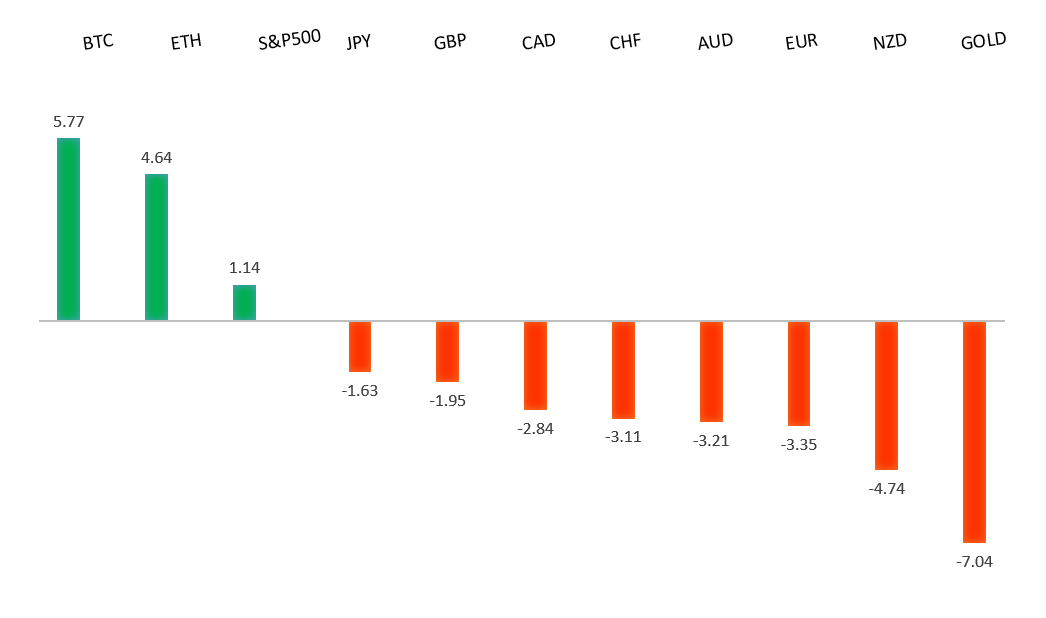
| Performance chart 30day v. USD (%) | ||
 | ||
| Technical & fundamental highlights | ||
| EURUSD: technical overview | ||
| The Euro continues to show signs of wanting to carve out a major bottom after trading down to a 20-year low in 2022. Setbacks should be exceptionally well supported above 1.1000 on a weekly close basis ahead of the next major upside extension back above 1.2000. | ||
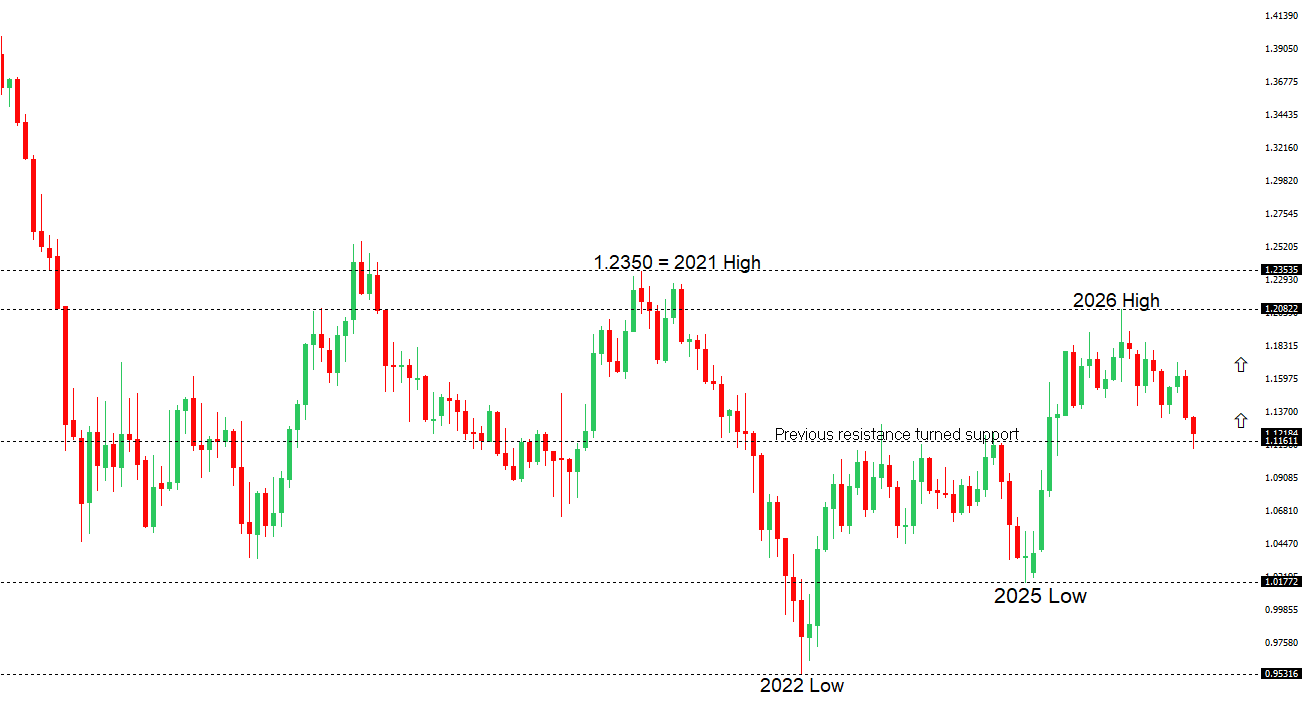 | ||
| R2 1.1337 - 1 October high - Medium R1 1.1270 - 16 October high - Medium S1 1.1121 - 28 Octoberber low - Medium S2 1.1113 - 14 Octoberber/2026 low - Strong | ||
| EURUSD: fundamental overview | ||
| The Euro remains on the defensive, weighed down by renewed concerns over France’s fiscal position and a broader recovery in the US Dollar ahead of this week’s major central bank decisions. Political and fiscal uncertainty in France continues to unsettle European bond markets, adding to pressure on the single currency despite signs of resilience in the broader Eurozone economy. Recent improvement in German business sentiment has offered some encouragement, though investors remain cautious about the region’s growth outlook and the implications of tighter financial conditions. Attention now turns to Thursday’s ECB decision, with policymakers widely expected to leave the deposit rate unchanged at 2.50%, while markets continue to price the possibility of another rate hike in December. President Lagarde’s assessment of inflation risks, economic activity and French bond market volatility will be particularly important in shaping expectations. Meanwhile, Wednesday’s Fed decision presents another significant catalyst, with stronger US economic data reinforcing Dollar demand ahead of the announcement. With both central banks expected to remain on hold, the immediate direction could ultimately depend on which delivers the more hawkish message, particularly given the extent to which expectations for further tightening have already been priced into US rates. | ||
| GBPUSD: technical overview | ||
| The Pound remains exceptionally well supported on dips into the 1.3000 area, with the price largely consolidating above the psychological barrier and previous resistance turned support in the form of the 2023 high. Look for the market to continue be well supported on dips ahead of the next major upside extension through the yearly high at 1.3870 and towards a retest of the 2018 high at 1.4377 further up. Only a monthly close below 1.3000 negates. | ||
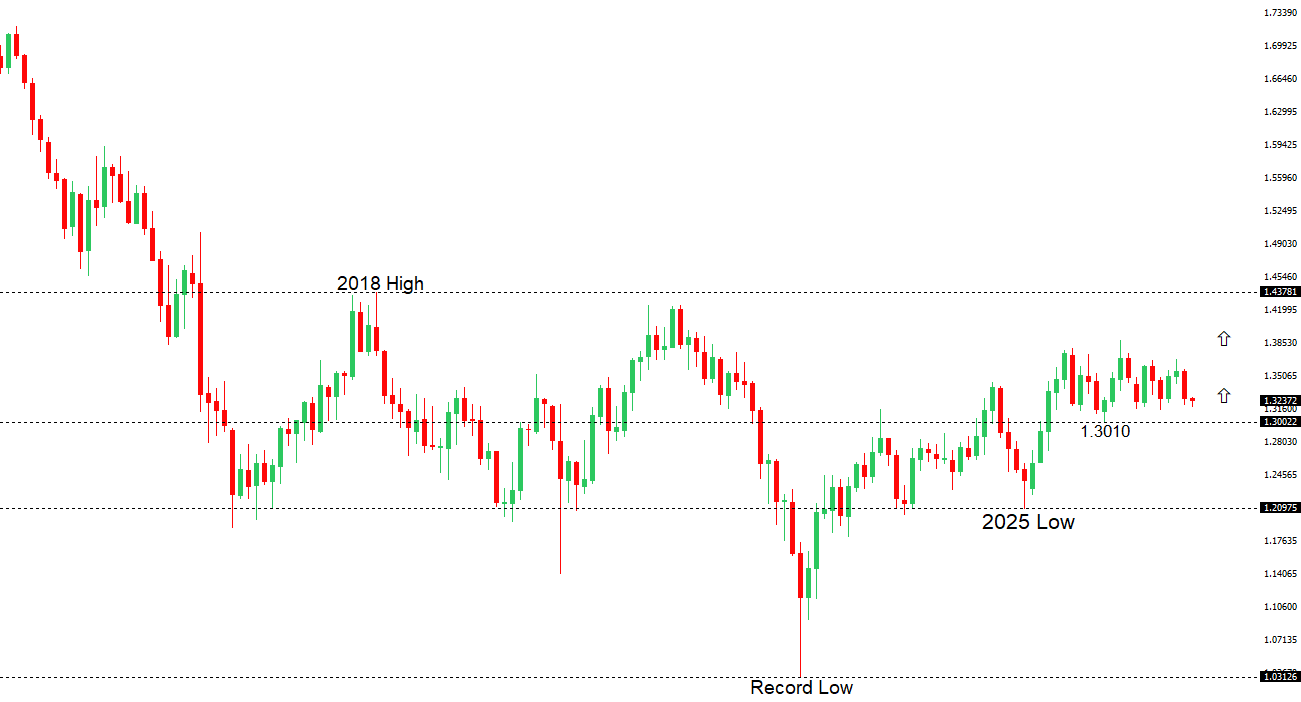 | ||
| R2 1.3498 - 16 September high - Medium R1 1.3420 - 22 October high - Medium S1 1.3264 - 16 October low - Medium S2 1.3137 - 14 October/2026 low - Strong | ||
| GBPUSD: fundamental overview | ||
| The Pound has remained under pressure against the US Dollar, extending its losing streak as investors position ahead of Wednesday’s Federal Reserve decision and the UK Autumn Budget. Sterling’s weakness has been driven primarily by renewed Dollar demand, supported by stronger US economic data, including an unexpected improvement in consumer confidence and a solid rebound in durable goods orders. Meanwhile, the Pound has shown greater resilience against the Euro, suggesting the recent decline has been more about Dollar strength than a deterioration in UK fundamentals. On the domestic front, attention is firmly on Chancellor Healey’s Budget, with markets particularly sensitive to the government’s fiscal plans, borrowing requirements and potential implications for gilt yields. Investors will be looking for reassurance that fiscal discipline can be maintained without further undermining an already fragile growth outlook. The Bank of England’s policy trajectory also remains in focus, with softer UK economic activity and easing inflation pressures keeping expectations for eventual monetary easing alive. With both the Budget and Fed decision approaching, Sterling remains vulnerable to near-term volatility, though a credible fiscal package and a less hawkish Fed could help restore support for the currency. | ||
| USDJPY: technical overview | ||
| The recent breakdown below 155.00 suggests the market could be on the verge of a bigger structural shift, with the possibility for an end to a longer-term uptrend and the start to a period of persistent weakness. Critical support now comes in the form of the 2026 low from January at 151.97, with a drop below to strengthen the bearish outlook and open the door for a major downside extension targeting the 2024 low at 139.58. The market would need to get back above 160.00 to take the immediate pressure off the downside. | ||
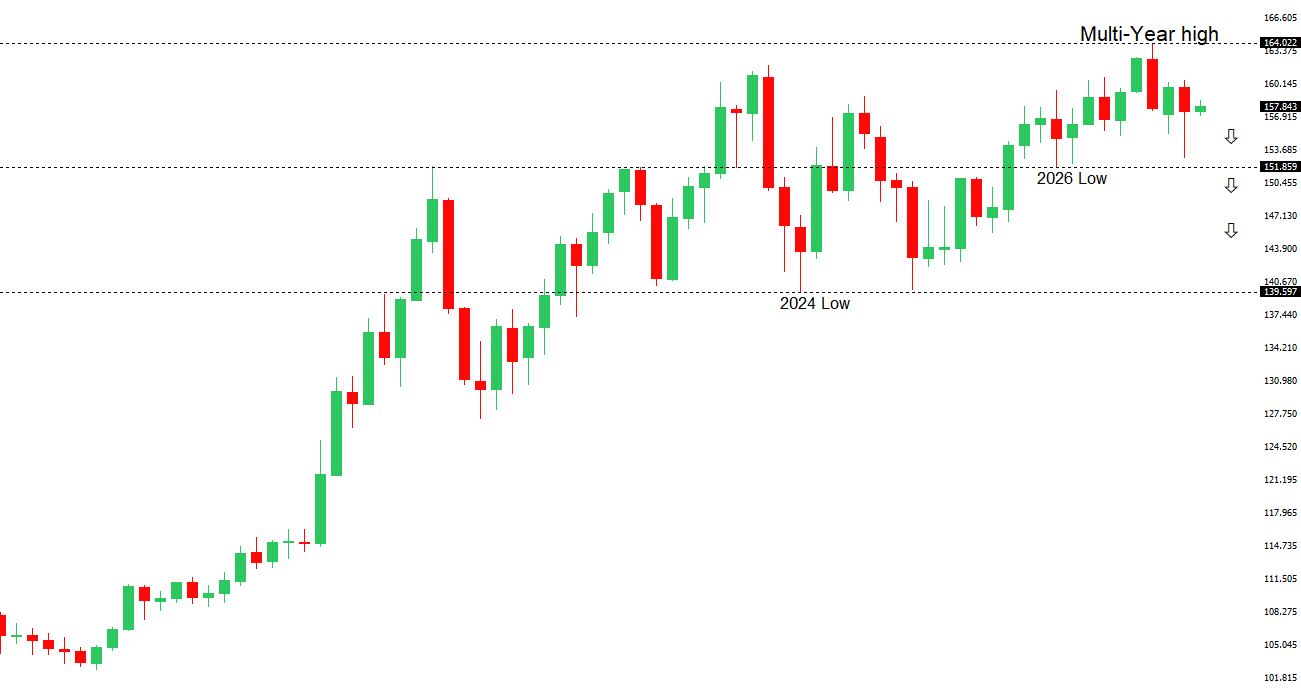 | ||
| R2 159.04 - 24 September high - Strong R1 158.26 - 22 October high - Medium S1 156.07 - 23 October low - Medium S2 155.29 - 4 September low - Strong | ||
| USDJPY: fundamental overview | ||
| The Yen has remained under pressure against the US Dollar, with the recovery in USDJPY reflecting renewed Dollar demand and persistent uncertainty surrounding the Bank of Japan’s policy outlook. Expectations that the BoJ will leave interest rates unchanged at Friday’s meeting have reinforced the appeal of carry trades, particularly as investors question how quickly Japanese policymakers will be prepared to resume monetary tightening. Attention will be on Governor Ueda’s guidance for future rate hikes, with upcoming Tokyo inflation figures also offering important clues on underlying price pressures. Meanwhile, the widening focus on the Fed’s hawkish stance and the prospect of US interest rates remaining elevated have continued to favor the Dollar, while geopolitical tensions in the Middle East have provided an additional source of safe-haven demand. With the Fed decision arriving Wednesday and the BoJ announcement following Friday, the near-term direction of the Yen will likely hinge on any shift in policy expectations and the outlook for US-Japan interest rate differentials. | ||
| AUDUSD: technical overview | ||
| There are signs of the formation of a longer-term base with the market recovering out from a meaningful longer-term support zone. The latest monthly close back above 0.7000 takes the big picture pressure off the downside and strengthens the case for a bottom, with the focus now on a push towards 0.8000. Setbacks should now be well supported ahead of 0.6700. | ||
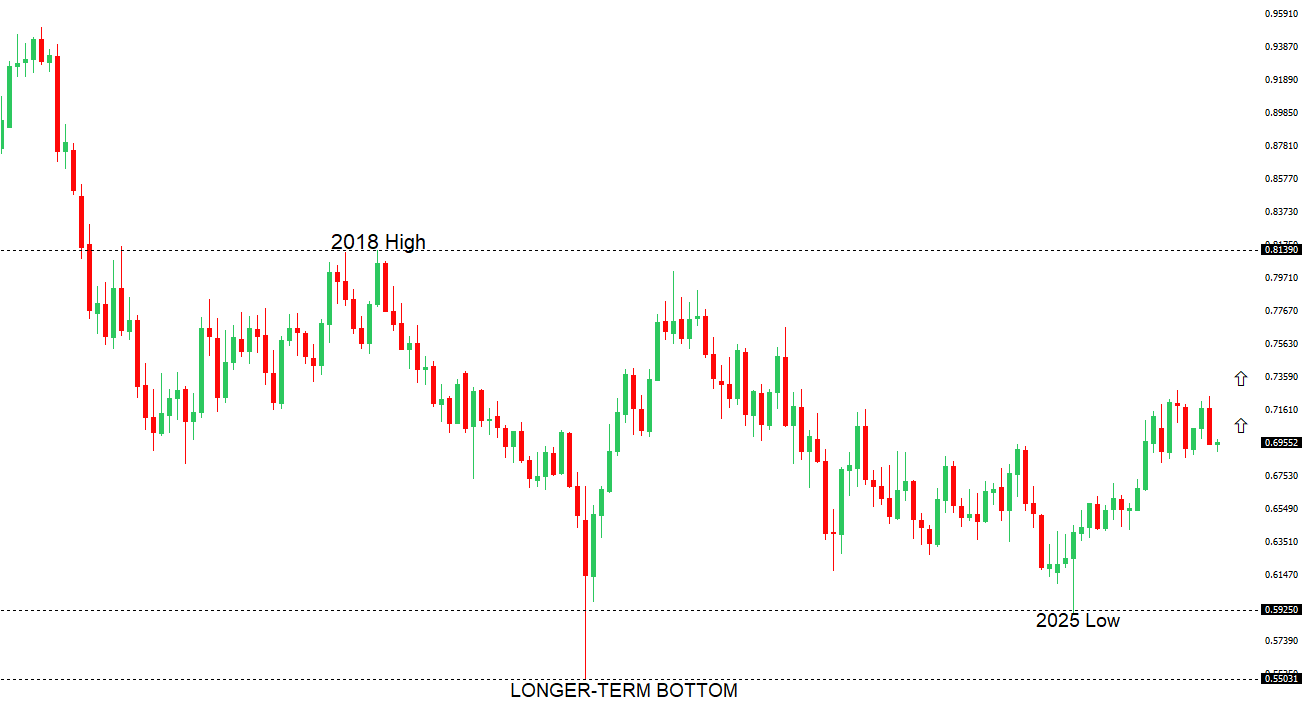 | ||
| R2 0.7100 - Figure - Medium R1 .7055 - 28 October high - Medium S1 0.6970 - 20 October low - Medium S2 0.6894 - 15 October low - Strong | ||
| AUDUSD: fundamental overview | ||
| The Australian Dollar has found renewed support from stronger-than-expected domestic inflation data, with September headline CPI accelerating to 4.3% year-on-year from 4.0% in August, reinforcing expectations that the Reserve Bank of Australia could raise interest rates as soon as November. The monthly increase of 0.8% and persistently elevated trimmed mean inflation underscore the challenge facing the RBA in bringing price pressures back within its 2–3% target range. The data have strengthened the case for further policy tightening and provided a fundamental tailwind for the Aussie, particularly as interest rate differentials remain an important driver of currency performance. However, gains have been tempered by renewed US Dollar demand ahead of the Federal Reserve’s policy announcement, with markets increasingly focused on the prospect of additional Fed tightening before year-end. Attention now turns to the Fed’s guidance and the upcoming RBA decision, with the balance of domestic inflation risks continuing to favor a relatively hawkish Australian monetary policy outlook. | ||
| Suggested reading | ||
| With a Rebuilt Wall of Worry, Tech Should Be Fine, Fisher Investments (October 26, 2026) To Notice a Lot, You Must Know Where to Look, J. Calhoun, Alhambra (October 25, 2026) | ||