


 | ||
| 11th November 2025 | view in browser | ||
| Dollar on the defensive as fed cuts loom | ||
| The U.S. dollar extended its retreat this week as weak labor data, political uncertainty, and a sell-off in AI stocks weighed on sentiment, though progress toward ending the record 40-day government shutdown offered some relief. | ||
| Performance chart 30day v. USD (%) | ||
 | ||
| Technical & fundamental highlights | ||
| EURUSD: technical overview | ||
| The Euro outlook remains constructive with higher lows sought out on dips in favor of the next major upside extension targeting the 2021 high at 1.2350. Setbacks should be exceptionally well supported ahead of 1.1300. | ||
 | ||
| R2 1.1729 - 17 October high -Strong R1 1.1669 - 28 October high - Medium S1 1.1469 - 5 November low - Medium S2 1.1392 - 1 August low - Strong | ||
| EURUSD: fundamental overview | ||
| ECB officials signaled growing optimism about the eurozone economy, noting easing inflation—particularly in services—and steadier growth than expected. Vice President de Guindos said the current interest rate level is appropriate, while Board member Elderson cited reduced global tensions and rising defense spending as supportive factors. Policymakers remain cautious about further rate cuts after eight reductions, holding the deposit rate at 2% as inflation nears target. Analysts at one major bank expect stable policy through mid-next year and a stronger euro ahead. Meanwhile, Germany’s November ZEW Survey is forecast to rise slightly to 41, reflecting cautious optimism amid ongoing economic challenges. | ||
| USDJPY: technical overview | ||
| There are signs of a meaningful top in place after the market put in a multi-year high in 2024. At this point, the door is now open for a deeper setback below the 2024 low at 139.58, exposing a retest of the 2023 low. Rallies should be well capped below 155.00. | ||
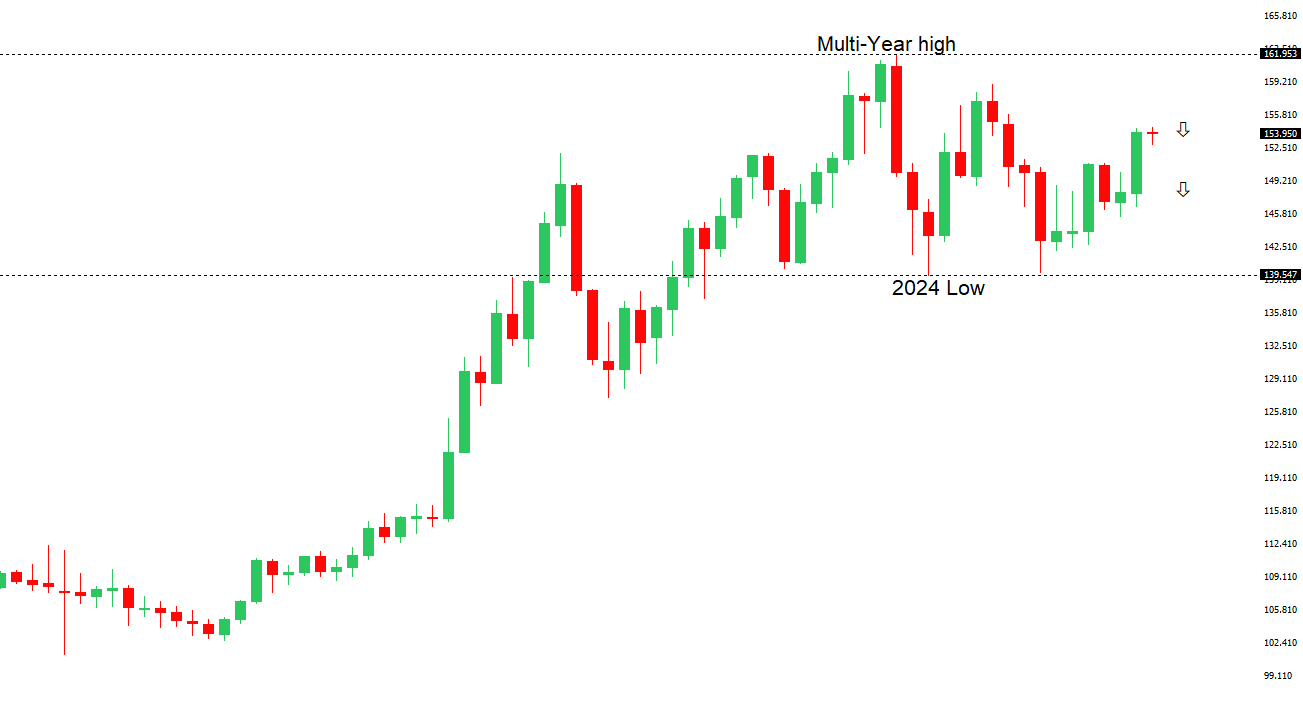 | ||
| R2 154.80 - 12 February high - Strong R1 154.50 - 11 November high - Medium S1 152.82 - 7 November low - Medium S2 151.54 - 29 October low - Strong | ||
| USDJPY: fundamental overview | ||
| The yen briefly strengthened past the November 4 high of 154.48 but lacked sustained gains. Optimism over a potential U.S. government reopening lifted Treasury yields and risk sentiment, keeping the yen weak. Meanwhile, Prime Minister Sanae Takaichi’s shift toward multi-year budgeting and higher spending reinforced expectations of continued fiscal stimulus and delayed Bank of Japan tightening. Her appointment of reflationist policymakers and a possible ¥15–20 trillion stimulus package further signaled prolonged easy conditions. However, BOJ comments suggested readiness for a cautious rate hike once inflation and growth targets are met. Still, any move is likely limited, and sustained yen strength would depend more on U.S. monetary policy—particularly if the Federal Reserve begins cutting rates more aggressively. | ||
| AUDUSD: technical overview | ||
| There are signs of the potential formation of a longer-term base with the market trading down into a meaningful longer-term support zone. Only a monthly close below 0.5500 would give reason for rethink. A monthly close back above 0.7000 will take the big picture pressure off the downside and strengthen case for a bottom. | ||
 | ||
| R2 0.6629 - 1 October high - Strong R1 0.6618 - 29 October high - Medium S1 0.6458 - 5 November low - Medium S1 0.6440 - 14 October low - Strong | ||
| AUDUSD: fundamental overview | ||
| RBA Deputy Governor Andrew Hauser highlighted that Australia’s economy is running near full capacity, limiting growth without sparking inflation. He stressed that higher productivity and investment are needed to expand supply and sustain growth. The RBA’s decision to hold rates at 3.6% and signal no easing until mid-2026 reinforces a focus on inflation control, supporting AUD strength, further buoyed by steady GDP growth, firm labour markets, and rising asset prices. Risk-on sentiment from U.S. political developments and resilient commodity prices also lift the Aussie, while undervaluation and reduced bearish positioning strengthen its medium-term outlook. Surging consumer confidence and solid business conditions point to renewed domestic optimism, though policymakers must balance this against potential inflation pressures. | ||
| Suggested reading | ||
| As AI Costs Collapse, Innovation Is Poised To Take Off, S. McBride, RiskHedge (November 7, 2025) Will the Growth of Stablecoins Drain Bank Deposits?, P. Kupiec, RCM (November 10, 2025) | ||