


 | ||
| 8th December 2025 | view in browser | ||
| Global markets steady as policy paths diverge | ||
| Global markets head into Monday with a cautious but constructive tone, led by the United States where easing inflation expectations and resilient consumers are reinforcing confidence in a gradual Federal Reserve easing cycle, even as price pressures remain uneven across goods and services. | ||
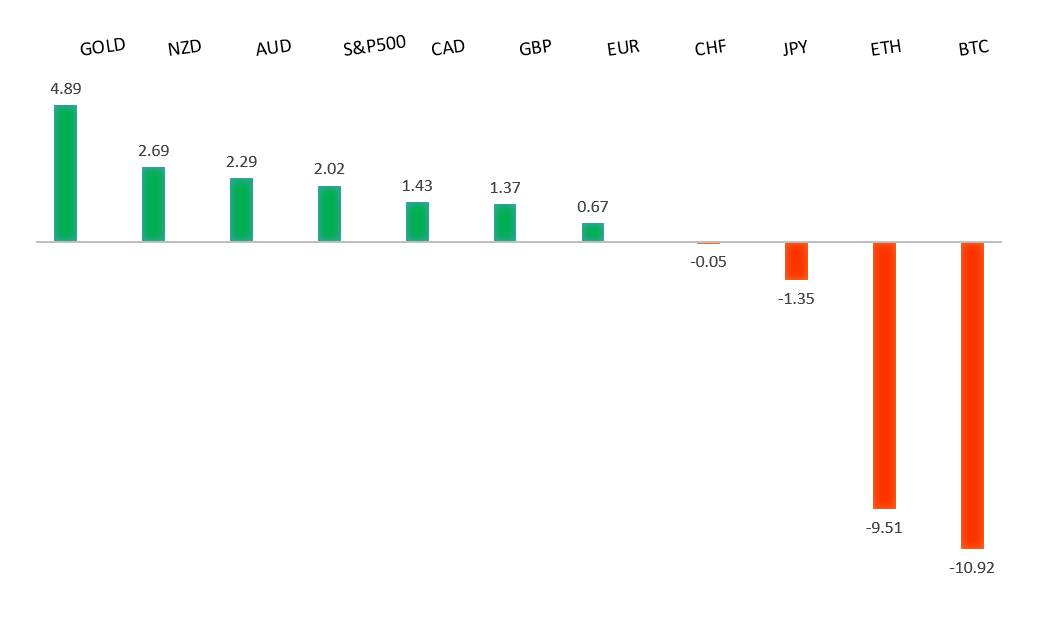
| Performance chart 30day v. USD (%) | ||
 | ||
| Technical & fundamental highlights | ||
| EURUSD: technical overview | ||
| The Euro outlook remains constructive with higher lows sought out on dips in favor of the next major upside extension targeting the 2021 high at 1.2350. Setbacks should be exceptionally well supported ahead of 1.1300. | ||
 | ||
| R2 1.1729 - 17 October high -Strong R1 1.1682 - 4 December high - Medium S1 1.1547 - 26 November low - Medium S2 1.1469 - 5 November low - Strong | ||
| EURUSD: fundamental overview | ||
| Euro-area growth in Q3 2025 was revised up to 0.3%, supported by stronger investment, consumption and solid wage growth, showing the economy has been more resilient than expected despite trade disruptions. This strength may lead ECB hawks to resist near-term easing, though easing pressures could return later as wage growth cools, with the ECB expected to raise its growth outlook next week. At the same time, a new Trump national security strategy signals a sharp shift away from Europe, adding geopolitical and market risks that have historically weighed on the euro and European equities. Looking ahead, upcoming data—particularly German industrial production—are likely to confirm fragile stabilization rather than a strong recovery, with industry still stuck in a low-growth environment. | ||
| USDJPY: technical overview | ||
| There are signs of a meaningful top in place after the market put in a multi-year high in 2024. At this point, rallies should be well capped ahead of 160.00 ahead of a fresh down-leg back towards the 2024 low at 139.58. | ||
 | ||
| R2 158.90 - 20 November/2025 high - Strong R1 156.59 - 28 November high - Medium S1 154.00 - Figure - Medium S2 153.61 - 14 November low - Strong | ||
| USDJPY: fundamental overview | ||
| USDJPY is slightly biased lower over the next one to two weeks, as markets increasingly price in a December BOJ rate hike and expect year-end dollar softness to support further yen strength. A hike from 0.5% to 0.75% is now the base case, helping pull USDJPY off recent highs, with officials seen pushing back against renewed weakness around the 158–160 zone. While Japanese data show moderate inflation, steady nominal wage growth and solid credit conditions, weak real wages and contracting GDP point to soft domestic demand. This supports a cautious BOJ outlook: policy normalization can continue gradually, but markets are likely to temper expectations for aggressive tightening beyond December. | ||
| AUDUSD: technical overview | ||
| There are signs of the potential formation of a longer-term base with the market trading down into a meaningful longer-term support zone. Only a monthly close below 0.5500 would give reason for rethink. A monthly close back above 0.7000 will take the big picture pressure off the downside and strengthen case for a bottom. | ||
 | ||
| R2 0.6707 - 17 September/2025 high - Strong R1 0.6660 - 18 September high - Medium S1 0.6520 - 28 November low - Medium S2 0.6421 - 21 November low - Strong | ||
| AUDUSD: fundamental overview | ||
| The Australian dollar has climbed to a two-and-a-half-month high as markets anticipate diverging paths between the Fed and the RBA, with U.S. data reinforcing expectations of an imminent Fed rate cut. The RBA is widely expected to keep its cash rate unchanged at 3.6% in December, signaling a likely “hawkish hold” amid persistent inflation pressures, solid domestic demand, and an economy near full capacity, with some markets even pricing in possible rate hikes by 2026. While several analysts argue the next move in rates could be higher, others believe the easing cycle is not over, suggesting inflation may prove temporary and that economists’ forecasts still point to lower rates next year—highlighting a growing gap between market expectations and economist consensus on the AUD and policy outlook. | ||
| Suggested reading | ||
| There is No Substitute for Thinking, N. Maggiulli, Of Dollars and Data (December 2, 2025) Trillion-Dollar Club: Are The Mega-Cap Stocks Still Buys?, F. Lee, Morningstar (December 4, 2025) | ||