

Day Image
30th June 2026 | view in browser
Quarter-end flows challenge the dollar, not the narrative

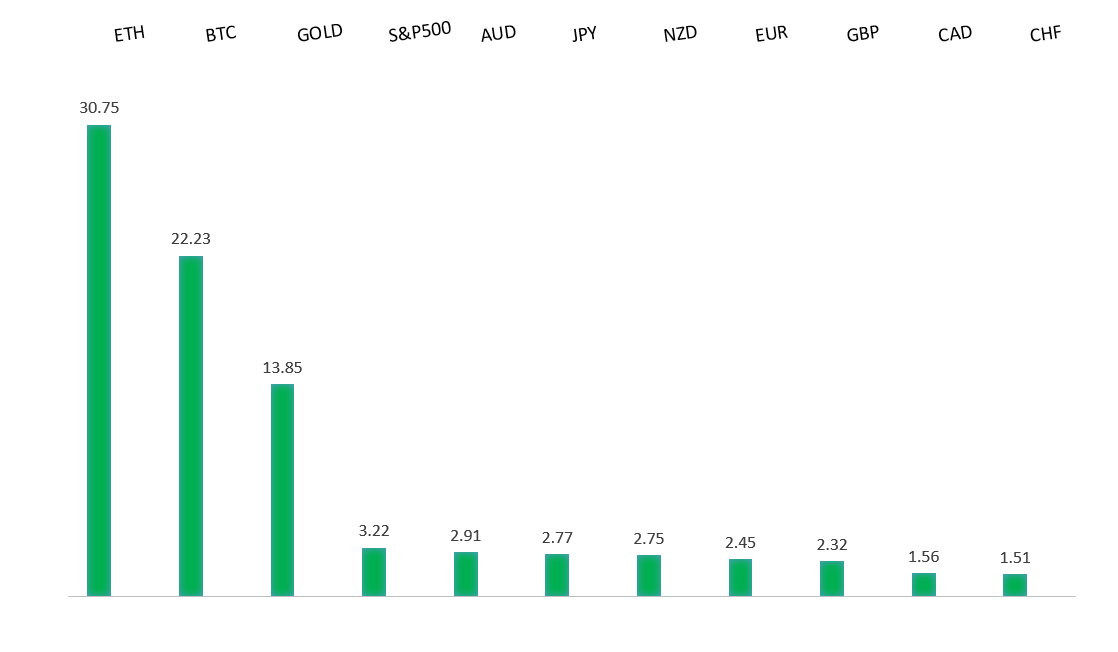
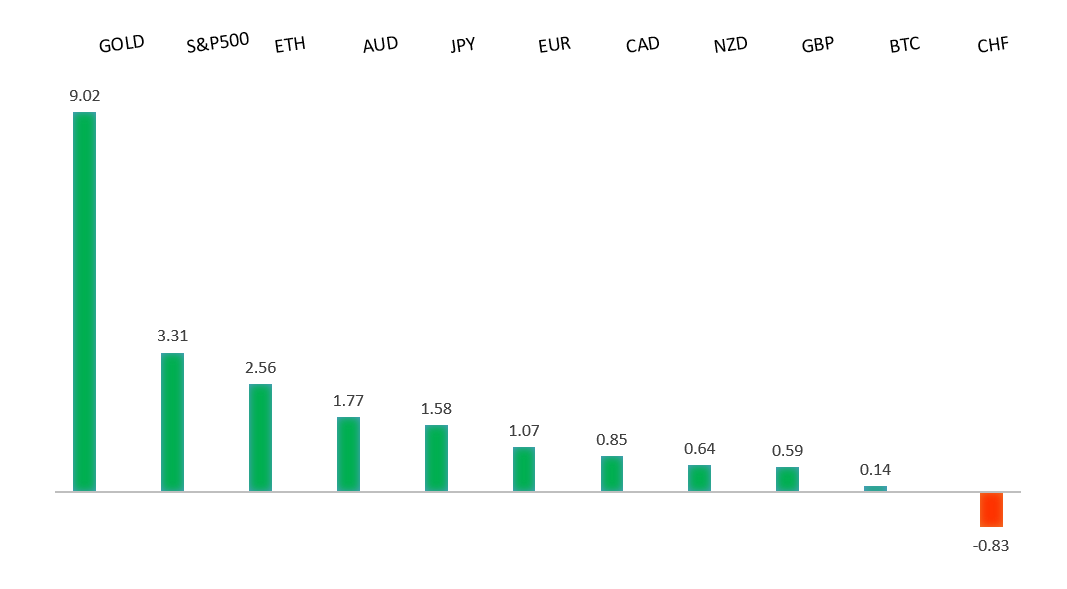
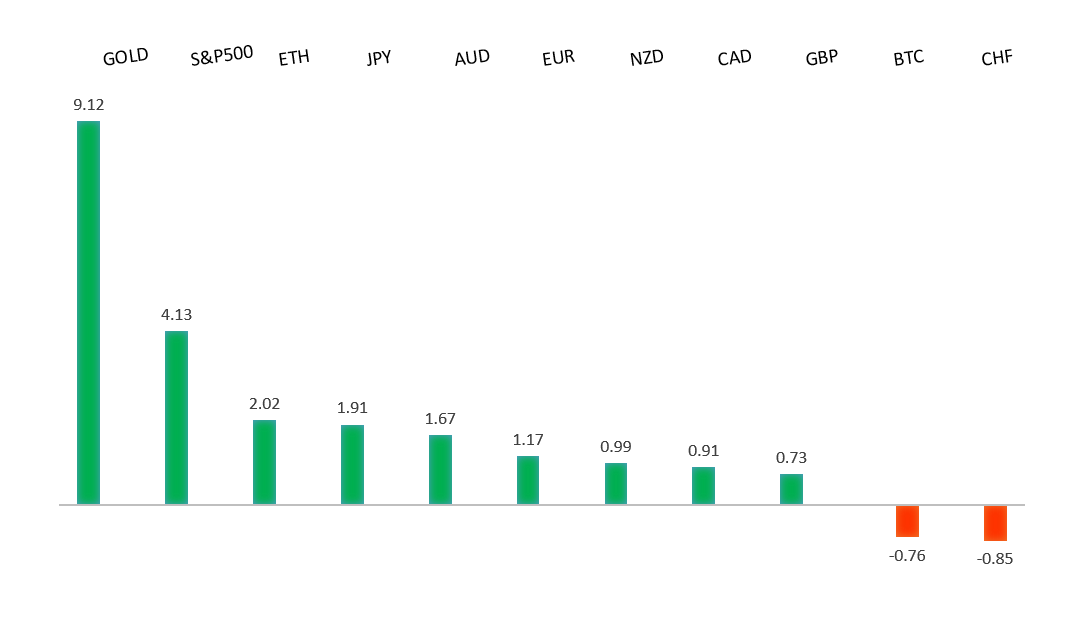
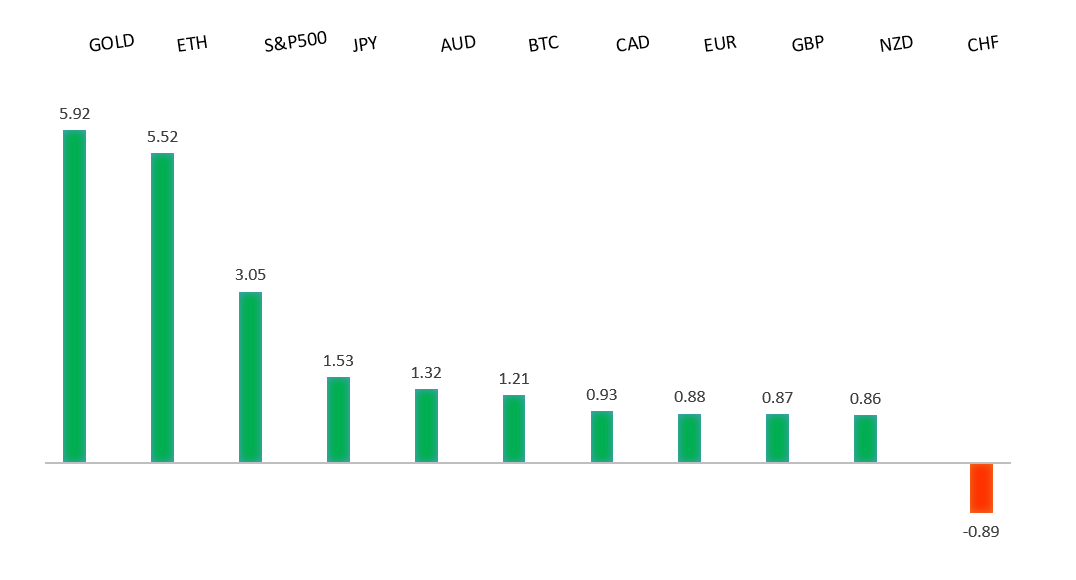
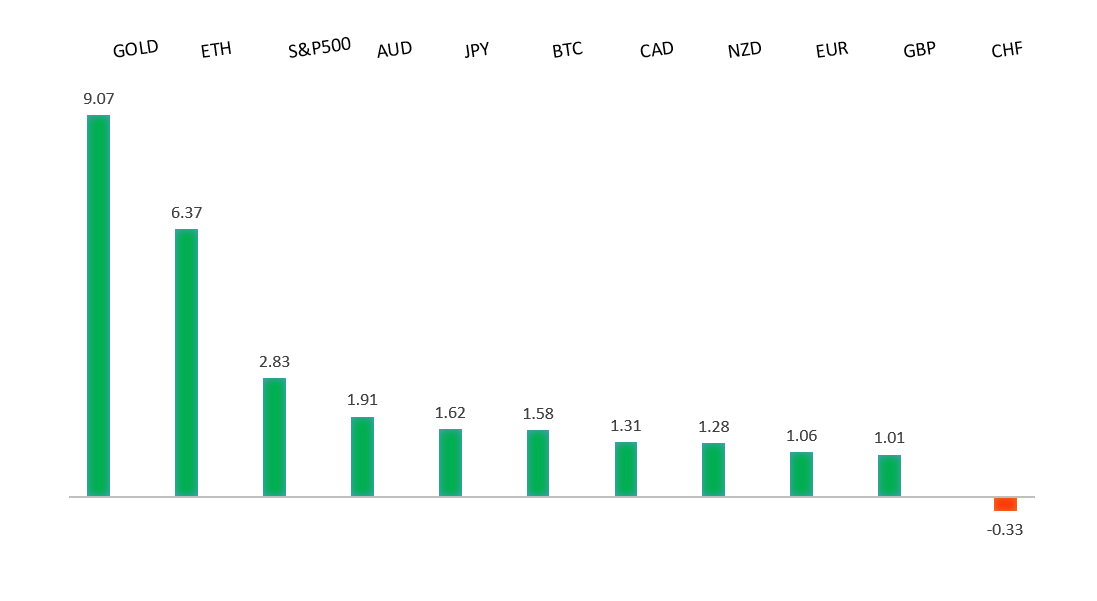
Quarter-end rebalancing and improving risk sentiment have sparked a modest pullback in the US dollar against the euro and pound, but markets remain anchored by the broader themes of Fed hawkishness, resilient US growth and easing energy prices as attention turns to central bank signals and key economic data later this week.


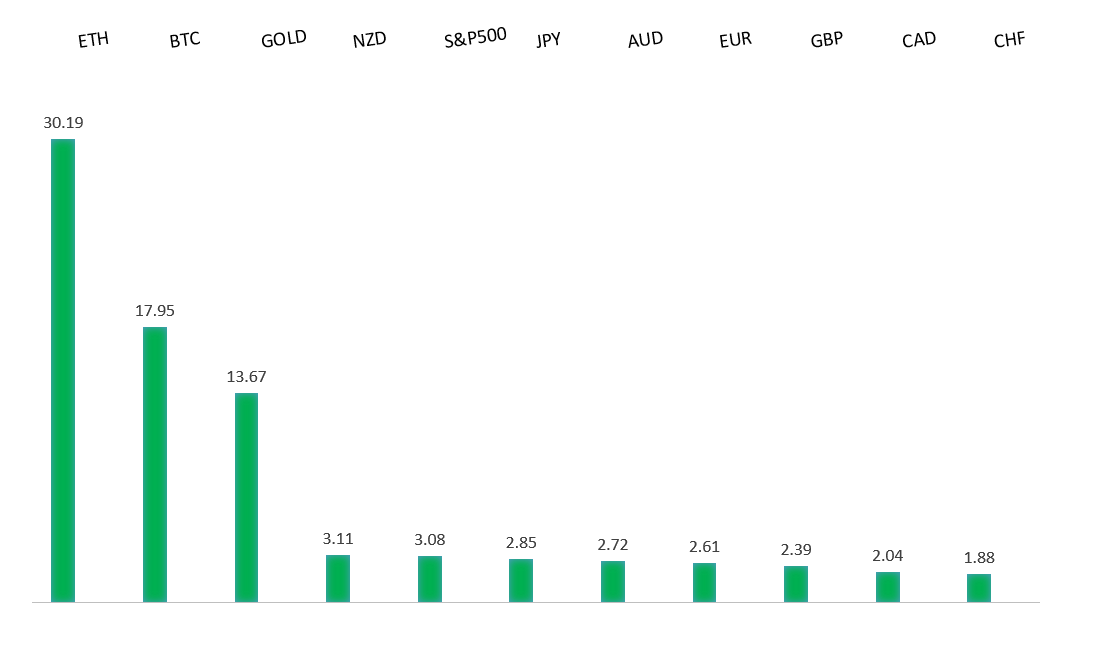
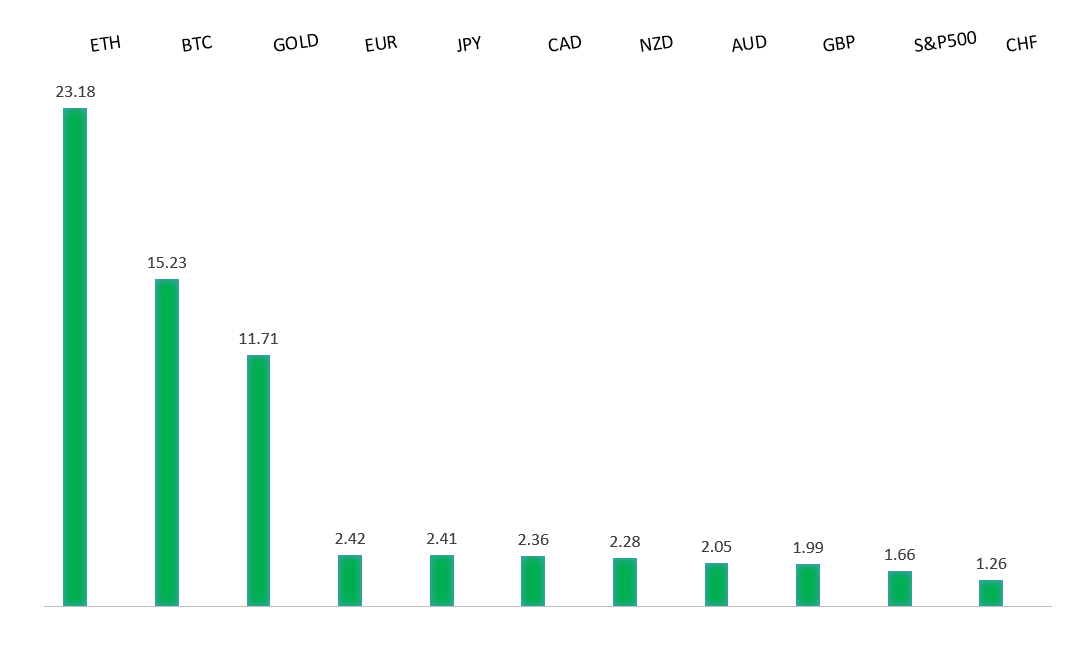
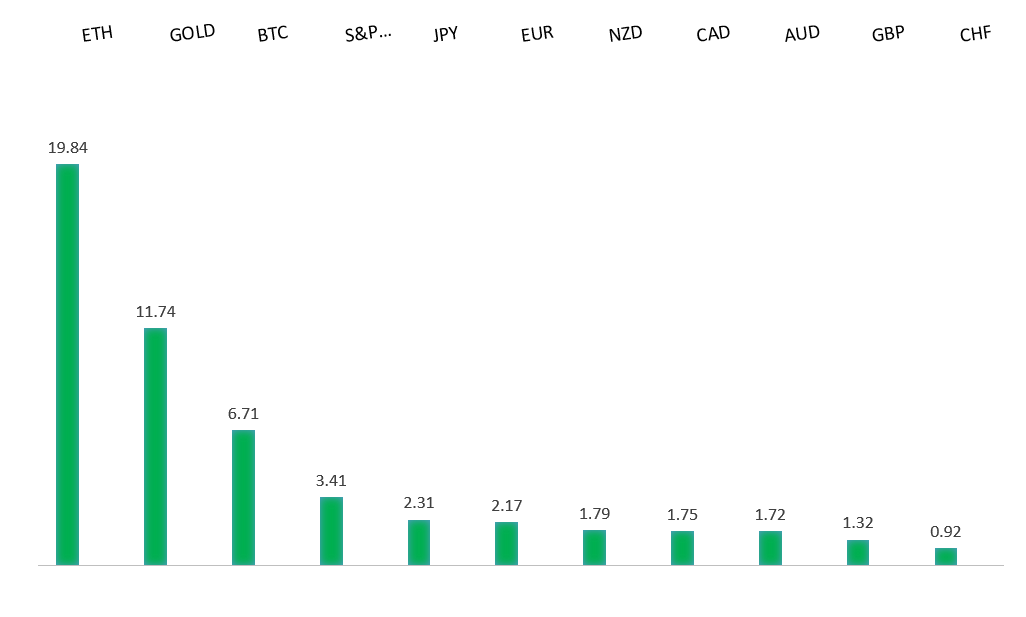
Performance chart 30day v. USD (%)
Performance Chart
 
 
Technical & fundamental highlights
EURUSD: technical overview

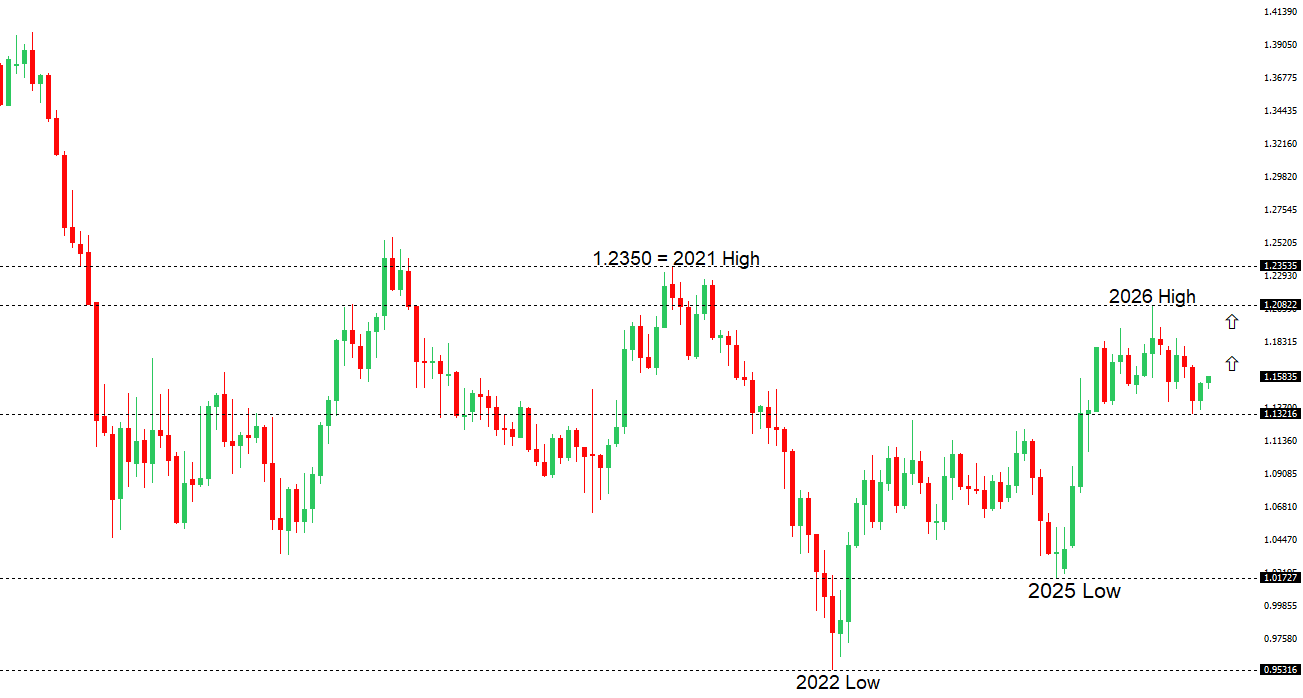
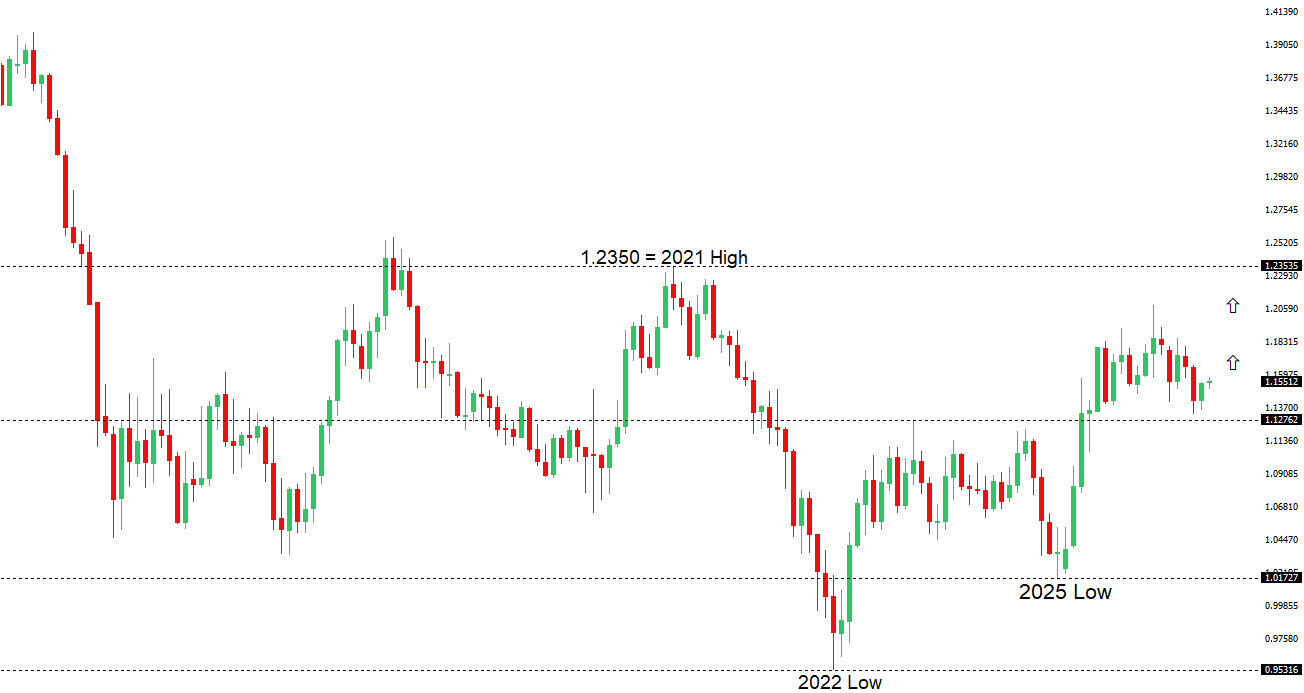
The Euro outlook remains constructive with higher lows sought out on dips in favor of the next major upside extension targeting the 2021 high at 1.2350. Setbacks should be exceptionally well supported ahead of 1.1300.

EURUSD Chart
R2 1.1529 - 18 June high - Medium
R1 1.1440 - 23 June high - Medium
S1 1.1325 - 24 June/2026 low - Medium
S2 1.1300 - Figure - Medium
EURUSD: fundamental overview

The euro has regained some footing as broad US Dollar weakness, improving regional sentiment and renewed confidence in the Eurozone investment story offset lingering geopolitical uncertainty. Markets are increasingly focused on this week’s ECB Forum in Sintra, where ECB President Christine Lagarde struck a notably hawkish tone by warning that future inflation shocks are likely to become more frequent while emphasizing that the Eurozone’s greater economic resilience gives the ECB room to raise rates again if necessary without threatening financial stability. That has reinforced expectations that the ECB will remain willing to keep policy restrictive should inflation reaccelerate, lending support to the single currency. Meanwhile, stronger-than-expected Eurozone economic sentiment has helped ease concerns over the region’s growth outlook ahead of key German inflation and retail sales data, with a firmer-than-expected HICP reading likely to further bolster the euro by supporting higher-for-longer rate expectations. Beyond monetary policy, falling energy prices following signs of easing tensions around the Strait of Hormuz have improved the outlook for European growth and corporate earnings, while renewed investor diversification away from concentrated US AI exposure has driven fresh inflows into European equities, providing an additional tailwind for the euro even as markets continue to monitor upcoming US labor market data for the next catalyst in EURUSD.

 
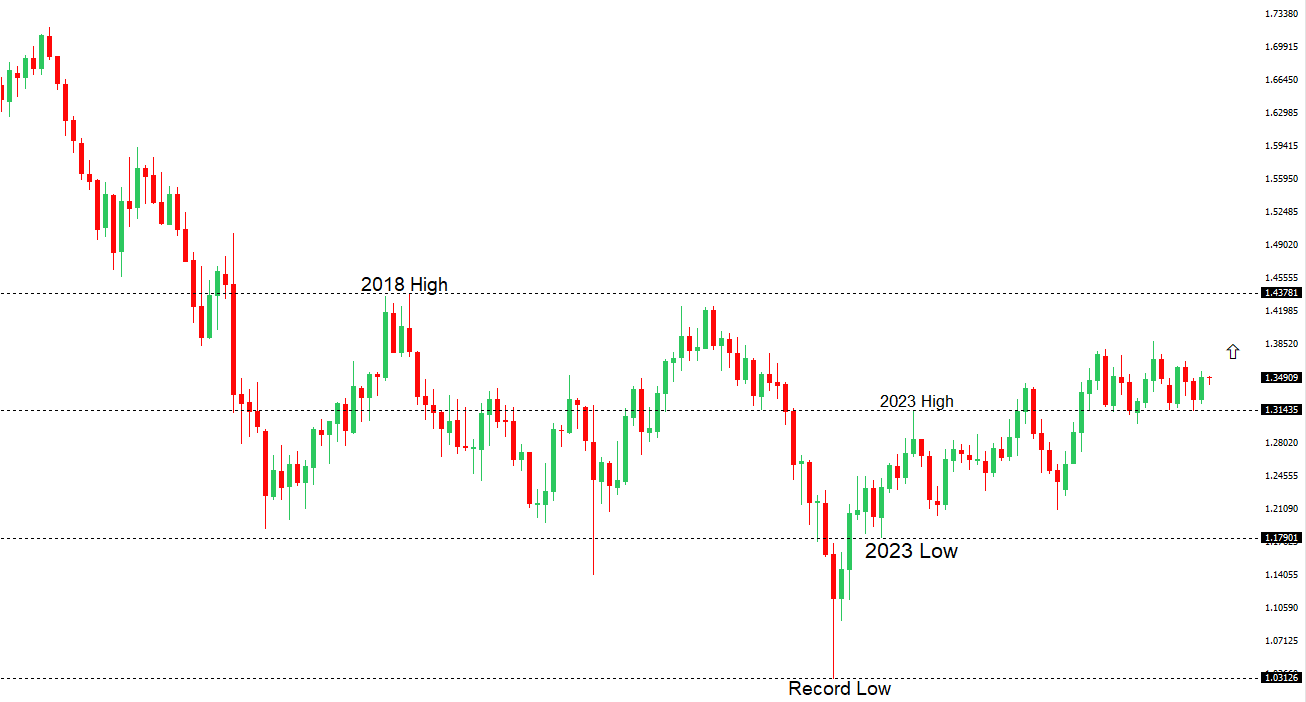
GBPUSD: technical overview

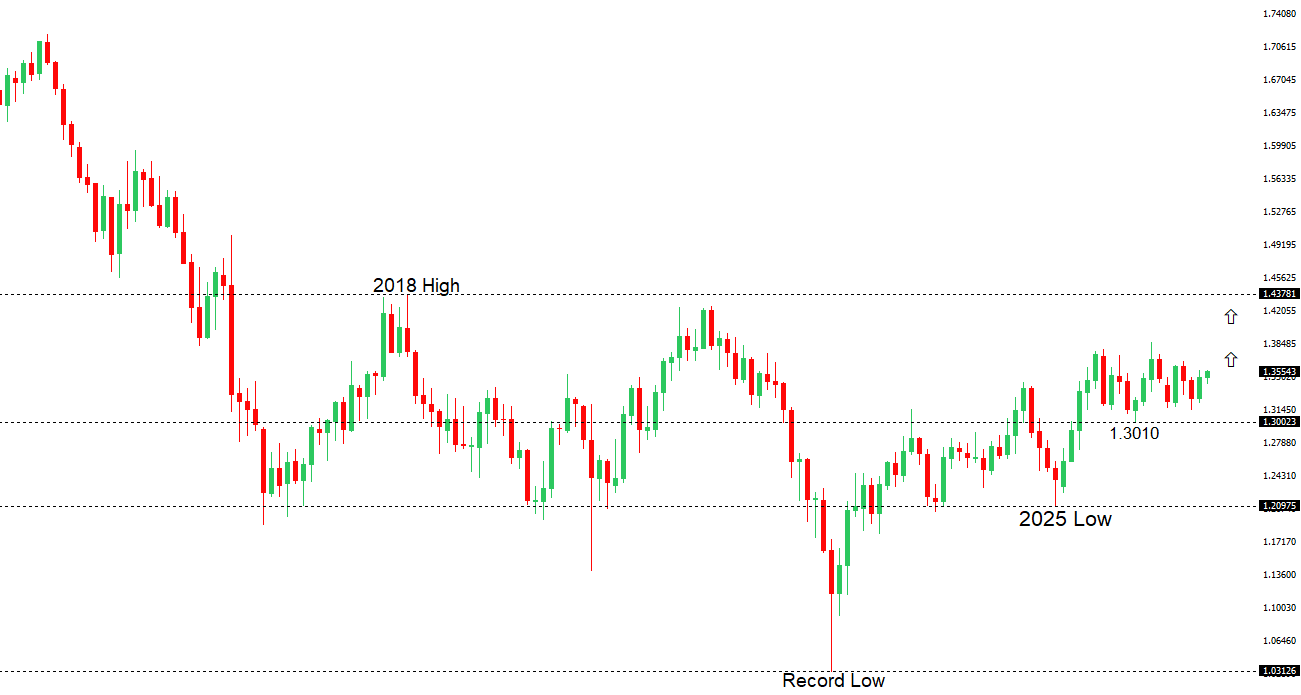
The Pound remains exceptionally well supported on dips into the 1.3000 area, with the price largely consolidating above the psychological barrier and previous resistance turned support in the form of the 2023 high. Look for the market to continue be well supported on dips ahead of the next major upside extension through the yearly high at 1.3870 and towards a retest of the 2018 high at 1.4377 further up. Only a monthly close below 1.3000 negates.

GBPUSD Chart
R2 1.3325 - 18 June high - Medium
R1 1.3274 - 22 June high - Medium
S1 1.3140 - 24 June/2026 low - Medium
S2 1.3100 - Figure - Medium
GBPUSD: fundamental overview

The pound has found renewed support as broad US Dollar weakness offsets lingering domestic uncertainty, allowing GBPUSD to recover toward multi-day highs. Sterling has also benefited from easing concerns over UK fiscal policy after expected incoming Prime Minister Andy Burnham pledged to maintain Chancellor Rachel Reeves’ fiscal rules and adhere to Labour’s existing fiscal framework, reassuring investors following a prolonged period of political instability. At the same time, improving sentiment surrounding a temporary easing in US-Iran tensions has supported broader risk appetite and weighed on the safe-haven US Dollar. However, upside for the pound remains tempered by expectations that the Bank of England will continue easing policy gradually as UK growth slows and inflation pressures continue to moderate. Attention now turns to a busy week of catalysts, including the UK’s first-quarter GDP data, the ECB’s Sintra Forum, comments from new Fed Chair Kevin Warsh, and crucial US labor market data, all of which will shape expectations for the relative policy outlook between the Bank of England and the Federal Reserve.

 
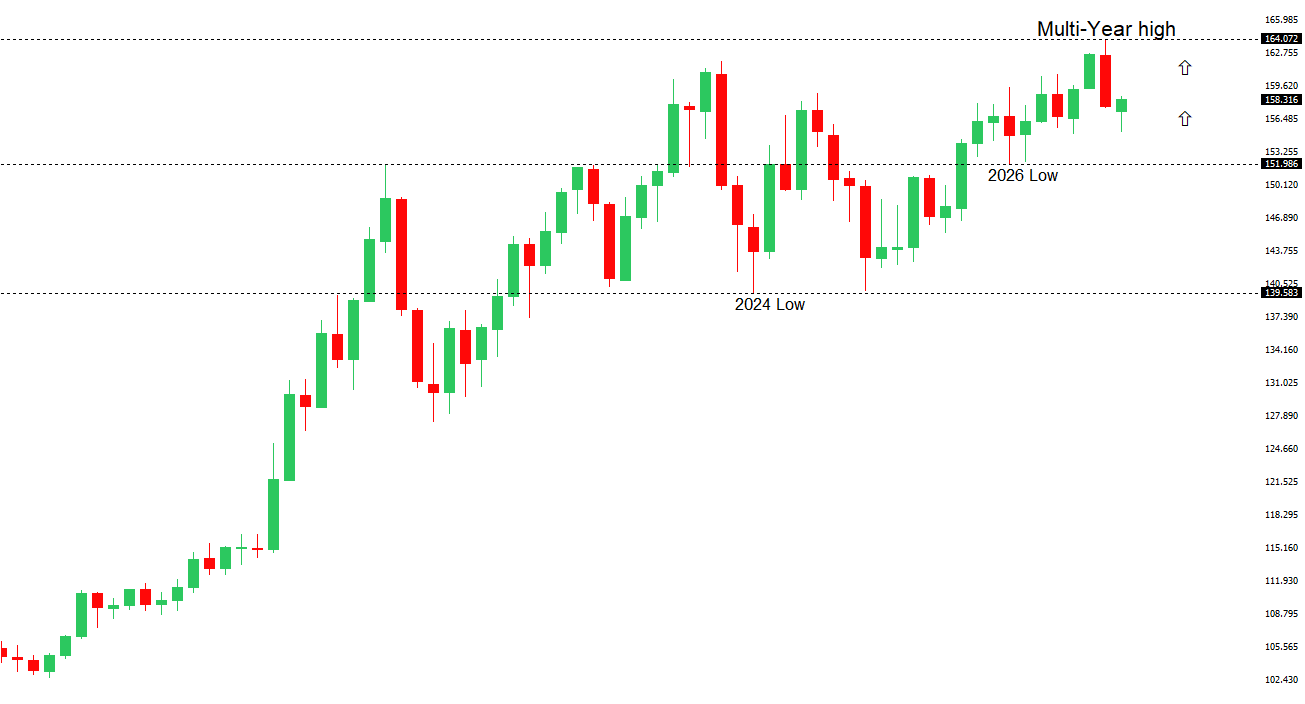
USDJPY: technical overview

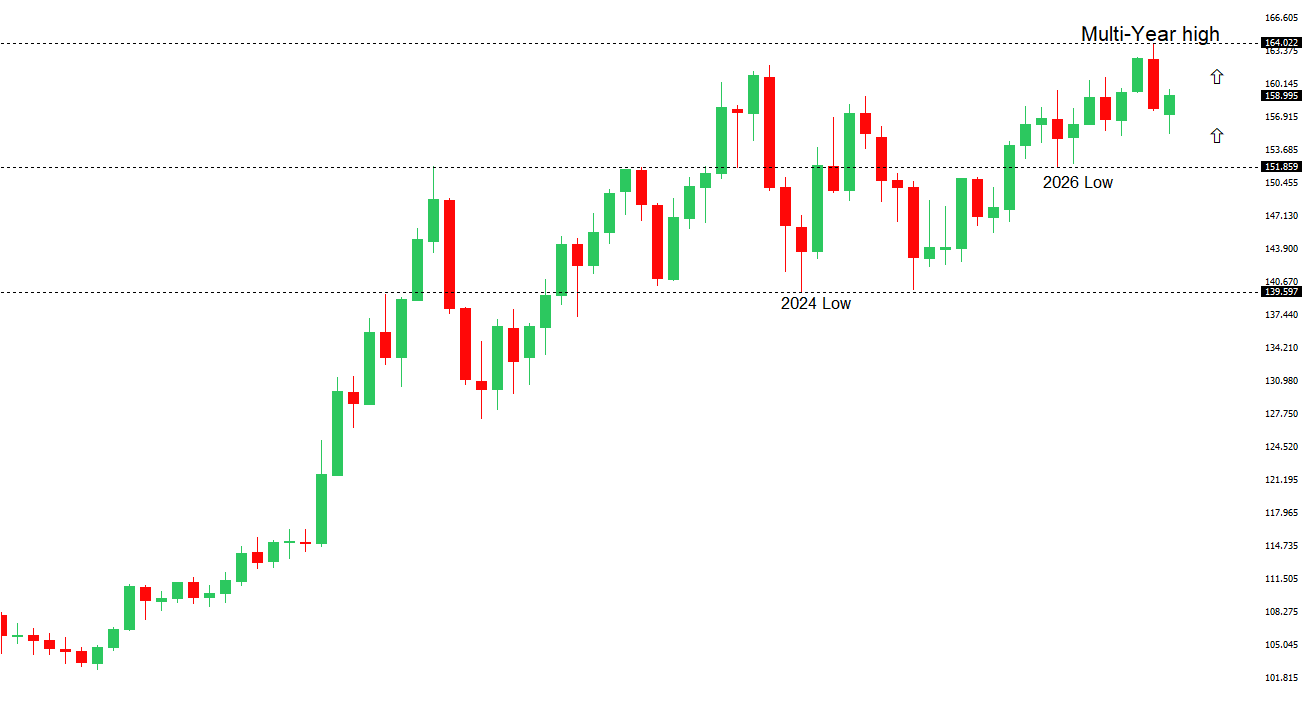
There are signs of the formation of a meaningful top after the market put in a multi-year high in 2024. At this point, rallies should be well capped below 162.00 in favor of a fresh down-leg back towards the 2024 low at 139.58. Only a monthly close above 162.00 negates.

USDJPY Chart
R2 163.00 - Figure - Medium
R1 161.99 - Multi-Year high/29 June 2026 - Very Strong
S1 160.41 - 18 June low - Medium
S2 159.54 - 11 June low - Strong
USDJPY: fundamental overview

The Yen remains under pressure as the wide interest rate differential between Japan and the United States continues to favor the US Dollar, although gains in USDJPY have become more cautious as the pair trades just below the closely watched 162.00 level. Markets remain highly alert to the risk of official intervention after repeated warnings from Japanese authorities that they stand ready to respond to excessive one-sided currency moves, helping to temper further Yen weakness. At the same time, investors are focused on this week’s key US data—including ISM surveys, JOLTS, ADP employment and, most importantly, Thursday’s US nonfarm payrolls report—which will shape expectations for the Federal Reserve’s policy path after markets further increased pricing for additional tightening. Domestically, stronger Japanese commercial sales and retail activity have offered some evidence of resilient demand, while renewed trade tensions with China following additional export controls on Japanese firms have added to geopolitical uncertainty and reinforced a modest risk premium for the Yen. Even so, persistent capital outflows, bearish market positioning and the dominant influence of broad US Dollar strength continue to outweigh supportive domestic factors, leaving USDJPY trading near multi-decade highs while intervention risks remain elevated.

 
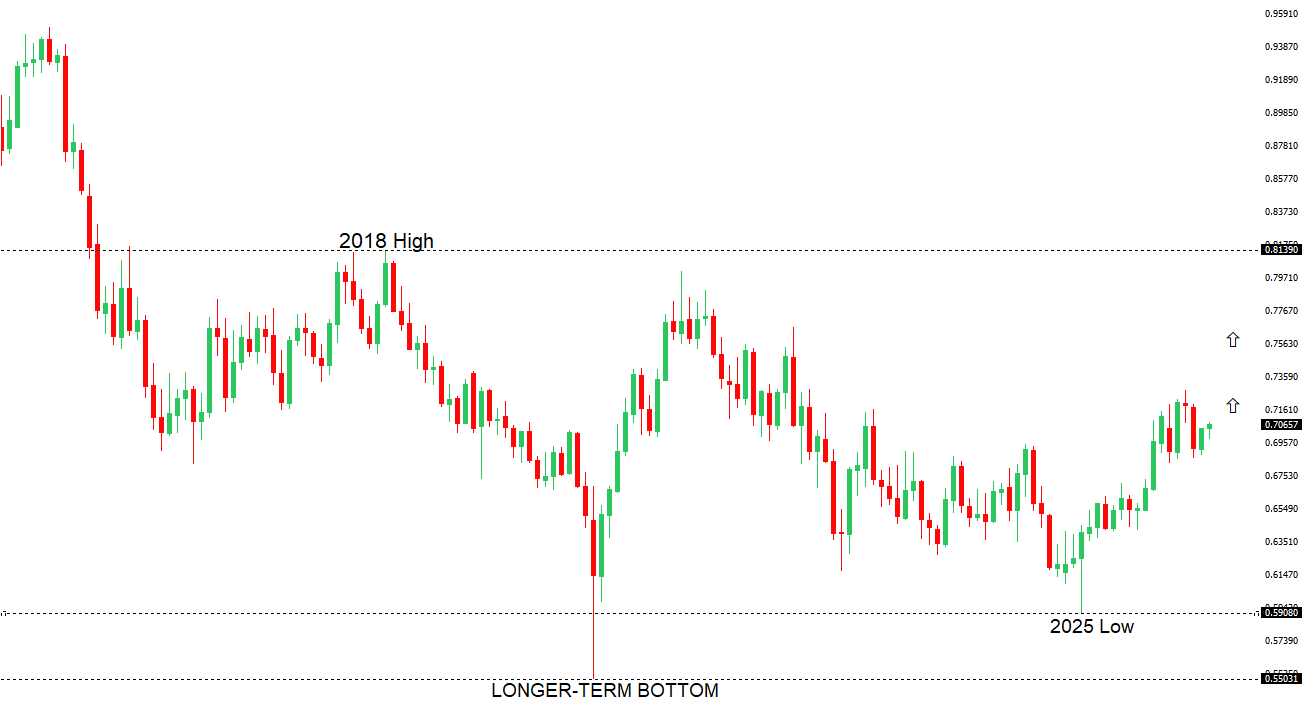
AUDUSD: technical overview

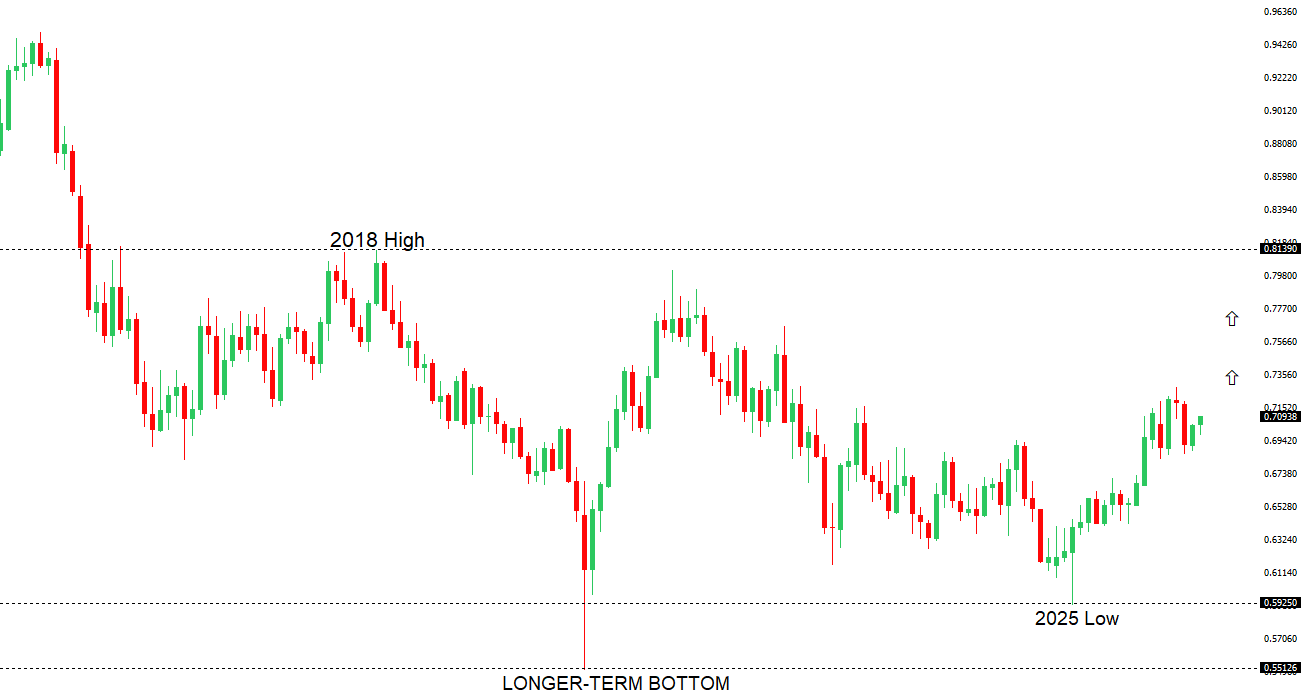
There are signs of the formation of a longer-term base with the market recovering out from a meaningful longer-term support zone. The latest monthly close back above 0.7000 takes the big picture pressure off the downside and strengthens the case for a bottom, with the focus now on a push towards 0.8000. Setbacks should now be well supported ahead of 0.6700.

AUDUSD Chart
R2 0.7089 - 15 June high - Strong
R1 0.6979 - 11 June low - Medium
S1 0.6875 - 26 June low - Medium
S2 0.6833 - 30 March low - Strong
AUDUSD: fundamental overview

The Australian Dollar remains under pressure, with AUDUSD slipping below 0.6900 as investors continue to reassess the Reserve Bank of Australia’s policy outlook despite lingering inflation concerns. Attention is firmly on the release of the RBA’s June meeting minutes, which are expected to provide greater insight into how high the bar is for another rate hike after the Bank unanimously left the cash rate unchanged at 4.35% while retaining an explicit tightening bias. Although policymakers continue to stress that inflation remains too high and have kept the option of further tightening alive, slowing economic growth and signs that previous rate increases are working have tempered expectations for imminent action, leaving markets questioning how hawkish the RBA will ultimately prove to be. At the same time, China remains a key swing factor for the Aussie, with upcoming PMI data expected to offer an important read on demand from Australia’s largest trading partner, where stronger activity would support the currency while softer figures would reinforce downside risks. Broader external factors are also playing a major role, with shifting expectations around US monetary policy, global risk sentiment and developments in the Middle East continuing to drive day-to-day price action. While easing geopolitical tensions have helped stabilize overall market sentiment, the combination of cautious RBA expectations, a still-resilient US Dollar backdrop and fading speculative positioning has left the Australian Dollar struggling to regain momentum despite domestic economic fundamentals remaining relatively resilient.

 
Suggested reading

A renewable energy revolution, L. Boulton Financial Times (June 29, 2026)

A Wave of Fed Interest Rate Cuts That May Never Come, R. Ross, Marketwatch (June 25, 2026)


Any opinions, news, research, analyses, prices or other information ("information") contained on this Blog, constitutes marketing communication and it has not been prepared in accordance with legal requirements designed to promote the independence of investment research. Further, the information contained within this Blog does not contain (and should not be construed as containing) investment advice or an investment recommendation, or an offer of, or solicitation for, a transaction in any financial instrument. LMAX Group has not verified the accuracy or basis-in-fact of any claim or statement made by any third parties as comments for every Blog entry.

LMAX Group will not accept liability for any loss or damage, including without limitation to, any loss of profit, which may arise directly or indirectly from use of or reliance on such information. No representation or warranty is given as to the accuracy or completeness of the above information. While the produced information was obtained from sources deemed to be reliable, LMAX Group does not provide any guarantees about the reliability of such sources. Consequently any person acting on it does so entirely at his or her own risk. It is not a place to slander, use unacceptable language or to promote LMAX Group or any other FX and CFD provider and any such postings, excessive or unjust comments and attacks will not be allowed and will be removed from the site immediately.

Day Image
29th June 2026 | view in browser
Geopolitical risk fades, but still not far enough

Markets enter the new week with investors balancing a hawkish Fed, key US jobs data and central bank guidance against renewed Middle East tensions, as the US Dollar remains firm, equities consolidate after recent weakness and oil geopolitical risks return to the forefront.


Performance chart 30day v. USD (%)
Performance Chart
 
 
Technical & fundamental highlights
EURUSD: technical overview

The Euro outlook remains constructive with higher lows sought out on dips in favor of the next major upside extension targeting the 2021 high at 1.2350. Setbacks should be exceptionally well supported ahead of 1.1300.

EURUSD Chart
R2 1.1529 - 18 June high - Medium
R1 1.1440 - 23 June high - Medium
S1 1.1325 - 24 June/2026 low - Medium
S2 1.1300 - Figure - Medium
EURUSD: fundamental overview

The euro remains under pressure against the US Dollar as markets continue to favor the Greenback amid a combination of geopolitical uncertainty and a more hawkish Federal Reserve outlook. Although softer-than-expected US PCE inflation data eased immediate expectations for another near-term Fed rate hike and triggered a modest pullback in the Dollar, Fed officials continue to signal that policy is likely to remain restrictive, keeping US yields elevated and limiting EURUSD upside. At the same time, lingering tensions in the Middle East, including uncertainty surrounding shipping through the Strait of Hormuz, continue to support safe-haven demand for the Dollar. On the Eurozone side, expectations for further ECB tightening have become more mixed as lower energy prices ease inflation pressures, although some policymakers and private-sector economists still see inflation remaining sticky enough to justify another rate increase later this year. As a result, the euro is finding some support from lingering ECB tightening expectations, but the broader backdrop continues to be dominated by Dollar strength driven by Fed policy divergence and geopolitical risks.

 
GBPUSD: technical overview

The Pound remains exceptionally well supported on dips into the 1.3000 area, with the price largely consolidating above the psychological barrier and previous resistance turned support in the form of the 2023 high. Look for the market to continue be well supported on dips ahead of the next major upside extension through the yearly high at 1.3870 and towards a retest of the 2018 high at 1.4377 further up. Only a monthly close below 1.3000 negates.

GBPUSD Chart
R2 1.3325 - 18 June high - Medium
R1 1.3274 - 22 June high - Medium
S1 1.3140 - 24 June/2026 low - Medium
S2 1.3100 - Figure - Medium
GBPUSD: fundamental overview

The pound has found some support after the recent US Dollar rally lost momentum, although it still ended the previous week under modest pressure as markets continue to balance a resilient US economy and hawkish Federal Reserve against domestic UK developments. Political uncertainty has eased following Keir Starmer’s resignation, with investors taking comfort from frontrunner Andy Burnham’s commitment to maintain Chancellor Rachel Reeves’ fiscal rules, helping calm concerns over a looser fiscal stance that had previously weighed on sterling and pushed Gilt yields higher. At the same time, expectations for additional Bank of England tightening have been scaled back, with markets now pricing only limited further rate hikes this year, reflecting confidence that UK inflation will continue to moderate. Looking ahead, focus shifts to next week’s UK GDP data alongside US nonfarm payrolls and Fed Chair Kevin Warsh’s congressional testimony, all of which could prove pivotal in shaping relative monetary policy expectations and the near-term direction for GBPUSD.

 
USDJPY: technical overview

There are signs of the formation of a meaningful top after the market put in a multi-year high in 2024. At this point, rallies should be well capped below 162.00 in favor of a fresh down-leg back towards the 2024 low at 139.58. Only a monthly close above 162.00 negates.

USDJPY Chart
R2 163.00 - Figure - Medium
R1 161.96 - Multi-Year high/2024 - Very Strong
S1 160.41 - 18 June low - Medium
S2 159.54 - 11 June low - Strong
USDJPY: fundamental overview

The Yen remains under pressure as the Bank of Japan’s long-awaited 25bp rate hike to 1.00% has done little to offset the still-wide interest rate differential with the United States, especially after the Federal Reserve maintained a hawkish stance and signaled rates are likely to remain elevated for longer. That continues to encourage carry trades and keeps USDJPY trading near multi-decade highs despite growing speculation that Japanese authorities could intervene again to support the currency. The prospect of further BoJ tightening later this year, together with periodic intervention fears, has helped limit the pace of Yen losses rather than reverse the trend, while bouts of geopolitical uncertainty in the Middle East have only provided modest safe-haven support as investors continue to favor the higher-yielding US Dollar. Looking ahead, markets are focused on Japan’s Tankan business survey for clues on the domestic economy and the BoJ’s policy path, while US labor market data and Federal Reserve communication remain the key drivers of rate expectations, with strong US data likely to reinforce Dollar strength and keep pressure on the Yen.

 
AUDUSD: technical overview

There are signs of the formation of a longer-term base with the market recovering out from a meaningful longer-term support zone. The latest monthly close back above 0.7000 takes the big picture pressure off the downside and strengthens the case for a bottom, with the focus now on a push towards 0.8000. Setbacks should now be well supported ahead of 0.6700.

AUDUSD Chart
R2 0.7089 - 15 June high - Strong
R1 0.6979 - 11 June low - Medium
S1 0.6875 - 26 June low - Medium
S2 0.6833 - 30 March low - Strong
AUDUSD: fundamental overview

The Australian Dollar remains under pressure as resilient US economic data, elevated geopolitical tensions in the Middle East and expectations that the Federal Reserve could still tighten policy again this year continue to underpin the US Dollar. While stronger-than-expected Australian employment data, with a solid rebound in job creation and unemployment edging back to 4.4%, has helped reinforce the view that the Reserve Bank of Australia can remain patient rather than rush into easing, the underlying details were softer, with weaker hours worked, rising underemployment and job gains concentrated in part-time positions pointing to a gradual cooling in labor market conditions. The Aussie has also found only limited support from month-end US Dollar profit-taking, with investors remaining cautious as China’s uneven economic recovery continues to cloud the outlook for Australian exports despite ongoing hopes for additional Chinese policy stimulus. Markets are now looking ahead to key US data and evolving Fed expectations, while developments in China and broader global risk sentiment remain important drivers for the Australian Dollar.

 
Suggested reading

Ten years after Brexit, L. Fisher, Financial Times (June 26, 2026)

Tethered To The Tail Of a Drunken Dragon, P. Harlalka, Bond Vigilantes (June 25, 2026)


Any opinions, news, research, analyses, prices or other information ("information") contained on this Blog, constitutes marketing communication and it has not been prepared in accordance with legal requirements designed to promote the independence of investment research. Further, the information contained within this Blog does not contain (and should not be construed as containing) investment advice or an investment recommendation, or an offer of, or solicitation for, a transaction in any financial instrument. LMAX Group has not verified the accuracy or basis-in-fact of any claim or statement made by any third parties as comments for every Blog entry.

LMAX Group will not accept liability for any loss or damage, including without limitation to, any loss of profit, which may arise directly or indirectly from use of or reliance on such information. No representation or warranty is given as to the accuracy or completeness of the above information. While the produced information was obtained from sources deemed to be reliable, LMAX Group does not provide any guarantees about the reliability of such sources. Consequently any person acting on it does so entirely at his or her own risk. It is not a place to slander, use unacceptable language or to promote LMAX Group or any other FX and CFD provider and any such postings, excessive or unjust comments and attacks will not be allowed and will be removed from the site immediately.

Day Image
25th June 2026 | view in browser
Dollar catches its breath as macro crosscurrents build

The US dollar is taking a breather after its recent rally as markets balance hawkish global central bank signals, easing oil prices, resilient AI-driven equity optimism and ongoing geopolitical uncertainty heading into another eventful session.


Performance chart 30day v. USD (%)
Performance Chart
 
 
Technical & fundamental highlights
EURUSD: technical overview

The Euro outlook remains constructive with higher lows sought out on dips in favor of the next major upside extension targeting the 2021 high at 1.2350. Setbacks should be exceptionally well supported ahead of 1.1300.

EURUSD Chart
R2 1.1529 - 18 June high - Medium
R1 1.1440 - 23 June high - Medium
S1 1.1325 - 24 June/2026 low - Medium
S2 1.1300 - Figure - Medium
EURUSD: fundamental overview

The euro remains under pressure against the US dollar, with EURUSD hovering around one-year lows as markets continue to favor the greenback on expectations that the Federal Reserve could keep policy tighter for longer, particularly if today’s US PCE inflation data reinforces the recent run of firm inflation and resilient economic activity. While the ECB has shifted to a more hawkish tone in recent weeks and remains alert to upside inflation risks, that has been outweighed by widening US yield support and stronger demand for the dollar. For now, the euro is finding some support around the 1.1350 area as investors await the PCE report, with a hotter-than-expected reading likely to strengthen Fed tightening expectations and add further downside pressure on EURUSD.

 
GBPUSD: technical overview

The Pound remains exceptionally well supported on dips into the 1.3000 area, with the price largely consolidating above the psychological barrier and previous resistance turned support in the form of the 2023 high. Look for the market to continue be well supported on dips ahead of the next major upside extension through the yearly high at 1.3870 and towards a retest of the 2018 high at 1.4377 further up. Only a monthly close below 1.3000 negates.

GBPUSD Chart
R2 1.3325 - 18 June high - Medium
R1 1.3274 - 22 June high - Medium
S1 1.3140 - 24 June/2026 low - Medium
S2 1.3100 - Figure - Medium
GBPUSD: fundamental overview

Sterling remains under pressure against the US Dollar as UK political uncertainty continues to weigh on sentiment following Prime Minister Keir Starmer’s resignation, with investors now focused on the leadership transition and the potential for a more expansionary fiscal agenda under a new government. At the same time, the widening policy divergence between the Bank of England and an increasingly hawkish Federal Reserve continues to favor the Dollar, as markets have sharply increased expectations for further US rate hikes after recent Fed messaging. While the pound has managed to stabilize above the mid-1.31s after its recent sell-off, upside remains limited ahead of the latest US PCE inflation data, which could further reinforce the higher-for-longer US rates narrative if inflation surprises to the upside. Broader risk sentiment has also remained cautious, leaving sterling vulnerable as political uncertainty at home combines with a stronger US Dollar backdrop.

 
USDJPY: technical overview

There are signs of the formation of a meaningful top after the market put in a multi-year high in 2024. At this point, rallies should be well capped below 162.00 in favor of a fresh down-leg back towards the 2024 low at 139.58. Only a monthly close above 162.00 negates.

USDJPY Chart
R2 161.96 - Multi-Year high/2024 - Very Strong
R1 161.93 - 22 June/2026 high - Strong
S1 160.41 - 18 June low - Medium
S2 159.54 - 11 June low - Strong
USDJPY: fundamental overview

The Yen remains under pressure, with USDJPY trading just below the 162.00 level and close to four-decade highs as the wide US-Japan interest rate differential continues to favor the US Dollar and keep carry trades attractive. While recent comments from Bank of Japan officials have reinforced expectations for further policy tightening, including board member Naoki Tamura’s view that rates should gradually move toward a neutral level around 2%, markets still see Japanese rates remaining well below US levels for the foreseeable future. At the same time, the BoJ’s June Summary of Opinions highlighted growing concern over inflation risks and a willingness among some policymakers to raise rates more quickly if needed. The Yen has found only modest support from renewed intervention warnings, with Japanese officials reiterating they stand ready to act against excessive currency moves and reports of close coordination between Tokyo and Washington helping to temper, but not reverse, Yen weakness. Attention now turns to the US PCE inflation report, which could reshape expectations for the Federal Reserve’s policy path and drive the next major move in USDJPY, while easing oil prices have provided only limited relief by slightly reducing concerns over imported inflation in Japan.

 
AUDUSD: technical overview

There are signs of the formation of a longer-term base with the market recovering out from a meaningful longer-term support zone. The latest monthly close back above 0.7000 takes the big picture pressure off the downside and strengthens the case for a bottom, with the focus now on a push towards 0.8000. Setbacks should now be well supported ahead of 0.6700.

AUDUSD Chart
R2 0.7089 - 15 June high - Strong
R1 0.6979 - 11 June low - Medium
S1 0.6882 - 24 June low - Medium
S2 0.6833 - 30 March low - Strong
AUDUSD: fundamental overview

The Australian dollar remains under modest pressure as broad US Dollar strength, driven by expectations that the Federal Reserve’s next policy move is more likely to be a rate hike than a cut, continues to dominate sentiment. Markets have priced in elevated odds of additional Fed tightening, while investors are awaiting the latest US PCE inflation data for fresh direction on the US rates outlook. Domestically, however, the Australian backdrop remains relatively resilient after stronger-than-expected May employment data showed the economy added 40.3K jobs and the unemployment rate edged down to 4.4%, reinforcing the view that labor market conditions remain tight. That should help keep the Reserve Bank of Australia cautious on easing and provide some underlying support for the Aussie, although for now the currency continues to be driven more by the stronger US Dollar and broader global risk sentiment than by domestic fundamentals.

 
Suggested reading

The Yen Needs A Lot More Than Market Intervention, D. Lachman, AEIdeas (June 23, 2026)

Magnificent 7 Correction May Signal a Healthy Stock Market, C. Ji, Marketwatch (June 23, 2026)


Any opinions, news, research, analyses, prices or other information ("information") contained on this Blog, constitutes marketing communication and it has not been prepared in accordance with legal requirements designed to promote the independence of investment research. Further, the information contained within this Blog does not contain (and should not be construed as containing) investment advice or an investment recommendation, or an offer of, or solicitation for, a transaction in any financial instrument. LMAX Group has not verified the accuracy or basis-in-fact of any claim or statement made by any third parties as comments for every Blog entry.

LMAX Group will not accept liability for any loss or damage, including without limitation to, any loss of profit, which may arise directly or indirectly from use of or reliance on such information. No representation or warranty is given as to the accuracy or completeness of the above information. While the produced information was obtained from sources deemed to be reliable, LMAX Group does not provide any guarantees about the reliability of such sources. Consequently any person acting on it does so entirely at his or her own risk. It is not a place to slander, use unacceptable language or to promote LMAX Group or any other FX and CFD provider and any such postings, excessive or unjust comments and attacks will not be allowed and will be removed from the site immediately.

Day Image
24th June 2026 | view in browser
Dollar dominance keeps global markets on the defensive

The US dollar remains the dominant force across global markets as investors price a more hawkish Fed, overshadowing increasingly hawkish signals from the BOJ and RBA, while equities face pressure from rising rate expectations and commodities remain caught between geopolitical risks and tighter financial conditions.


Performance chart 30day v. USD (%)
Performance Chart
 
 
Technical & fundamental highlights
EURUSD: technical overview

The Euro outlook remains constructive with higher lows sought out on dips in favor of the next major upside extension targeting the 2021 high at 1.2350. Setbacks should be exceptionally well supported ahead of 1.1300.

EURUSD Chart
R2 1.1529 - 18 June high - Medium
R1 1.1440 - 23 June high - Medium
S1 1.1361 - 24 June/2026 low - Medium
S2 1.1300 - Figure - Medium
EURUSD: fundamental overview

The euro remains under pressure, with EURUSD sliding to fresh one-year lows as a resurgent US Dollar continues to dominate the FX landscape. The main driver has been a sharp repricing of Federal Reserve expectations following last week’s FOMC meeting, where Chair Kevin Warsh reinforced a strong commitment to price stability, prompting markets to increase expectations for further US tightening and pushing US yields higher. At the same time, ongoing uncertainty around Middle East diplomacy has supported safe-haven demand for the Dollar, with conflicting signals emerging from US-Iran negotiations and continued efforts to contain regional tensions involving Israel and Hezbollah. On the Eurozone side, the euro is also facing headwinds from widening policy divergence as investors increasingly view the ECB as being closer to the end of its tightening cycle than the Fed. While recent Eurozone activity data has shown signs of stabilization and inflation remains above target, those factors have been overshadowed by the stronger US rate outlook and broad Dollar strength, leaving the single currency on the defensive despite increasingly oversold conditions.

 
GBPUSD: technical overview

The Pound remains exceptionally well supported on dips into the 1.3000 area, with the price largely consolidating above the psychological barrier and previous resistance turned support in the form of the 2023 high. Look for the market to continue be well supported on dips ahead of the next major upside extension through the yearly high at 1.3870 and towards a retest of the 2018 high at 1.4377 further up. Only a monthly close below 1.3000 negates.

GBPUSD Chart
R2 1.3509 - 25 May high - Strong
R1 1.3325 - 18 June high - Medium
S1 1.3163 - 19 June low - Medium
S2 1.3159 - 31 May/2026 low - Strong
GBPUSD: fundamental overview

The Pound remains under pressure, with GBPUSD weighed down by a combination of growing UK political uncertainty and a stronger US Dollar backdrop. Keir Starmer’s resignation as Prime Minister has injected fresh uncertainty into the UK outlook, with markets now focused on the Labour leadership transition and the potential implications for fiscal policy under a new government. Concerns that a future administration could loosen fiscal rules have added pressure to UK assets, particularly after recent volatility in gilt markets. At the same time, weaker UK economic data has reinforced concerns about slowing growth, with June’s flash Composite PMI falling deeper into contraction territory at a 14-month low, highlighting softening momentum across the private sector. Despite these domestic headwinds, sterling has generally held up better than many peers in recent sessions, suggesting some of the political risk may already have been partially priced in. Nevertheless, the broader driver remains the widening policy divergence between the Bank of England and a more hawkish Federal Reserve, with markets significantly increasing expectations for a Fed rate hike later this year following last week’s FOMC meeting. That shift in rate expectations, alongside resilient US data and lingering demand for the Dollar, continues to act as the main headwind for the pound.

 
USDJPY: technical overview

There are signs of the formation of a meaningful top after the market put in a multi-year high in 2024. At this point, rallies should be well capped below 162.00 in favor of a fresh down-leg back towards the 2024 low at 139.58. Only a monthly close above 162.00 negates.

USDJPY Chart
R2 161.96 - Multi-Year high/2024 - Very Strong
R1 161.93 - 22 June/2026 high - Strong
S1 160.41 - 18 June low - Medium
S2 159.54 - 11 June low - Strong
USDJPY: fundamental overview

The Yen remains under pressure as the combination of a surging US Dollar, rising Federal Reserve rate-hike expectations, and a still-wide US-Japan yield differential continues to favor USDJPY near multi-decade highs. While the Bank of Japan delivered a historic rate increase to 1.0% earlier this month and recent BOJ communications have reinforced expectations for further tightening, markets remain focused on the fact that Japanese rates are still exceptionally low relative to the US, limiting support for the currency. The latest BOJ Summary of Opinions revealed a growing hawkish faction pushing for rate hikes every few months and a policy rate closer to the estimated 2% neutral level, with economists increasingly expecting another hike by year-end and some even as soon as October. Strong inflation signals, including wholesale inflation running at a three-year high and persistent services-sector price pressures, strengthen the case for further normalization. However, geopolitical uncertainty surrounding the Middle East, elevated energy prices, and ongoing carry-trade demand continue to outweigh the BOJ’s tightening narrative for now, leaving the Yen near 40-year lows. Intervention concerns from Japanese authorities are helping cap USDJPY upside around the 162.00 area, but have so far failed to generate a sustained recovery in the currency.

 
AUDUSD: technical overview

There are signs of the formation of a longer-term base with the market recovering out from a meaningful longer-term support zone. The latest monthly close back above 0.7000 takes the big picture pressure off the downside and strengthens the case for a bottom, with the focus now on a push towards 0.8000. Setbacks should now be well supported ahead of 0.6700.

AUDUSD Chart
R2 0.7089 - 15 June high - Strong
R1 0.6979 - 11 June low - Medium
S1 0.6901 - 24 June low - Medium
S2 0.6833 - 30 March low - Strong
AUDUSD: fundamental overview

The Australian Dollar remains under pressure despite another upside surprise in underlying inflation, with May trimmed mean CPI rising 3.6% year-over-year and reinforcing expectations that the RBA may need to tighten policy further. Markets largely looked through the softer headline CPI print, focusing instead on evidence that underlying price pressures remain broad and sticky, particularly across housing and services, where rising rents, dwelling costs and wage-related pressures continue to challenge the RBA’s inflation mandate. One Aussie bank maintained its call for an August rate hike, arguing that second-round effects from higher energy, freight and input costs are increasingly feeding into the broader economy and keeping core inflation elevated. However, the hawkish domestic backdrop has failed to translate into Aussie strength as the currency continues to be weighed down by a resilient US Dollar, expectations for a still-restrictive Federal Reserve, softer global risk appetite and lingering concerns about the outlook for China, Australia’s largest trading partner. As a result, AUDUSD has drifted toward the 0.6900 area despite relatively solid Australian fundamentals, with external macro forces currently overwhelming the support normally provided by rising RBA tightening expectations.

 
Suggested reading

Can Tech Produce Growth Justifying Valuations?, J. Calhoun, Alhambra (June 22, 2026)

Billionaire Tycoon Says We’re Looking at Debt Wrong, S. Goldstein, Marketwatch (June 23, 2026)


Any opinions, news, research, analyses, prices or other information ("information") contained on this Blog, constitutes marketing communication and it has not been prepared in accordance with legal requirements designed to promote the independence of investment research. Further, the information contained within this Blog does not contain (and should not be construed as containing) investment advice or an investment recommendation, or an offer of, or solicitation for, a transaction in any financial instrument. LMAX Group has not verified the accuracy or basis-in-fact of any claim or statement made by any third parties as comments for every Blog entry.

LMAX Group will not accept liability for any loss or damage, including without limitation to, any loss of profit, which may arise directly or indirectly from use of or reliance on such information. No representation or warranty is given as to the accuracy or completeness of the above information. While the produced information was obtained from sources deemed to be reliable, LMAX Group does not provide any guarantees about the reliability of such sources. Consequently any person acting on it does so entirely at his or her own risk. It is not a place to slander, use unacceptable language or to promote LMAX Group or any other FX and CFD provider and any such postings, excessive or unjust comments and attacks will not be allowed and will be removed from the site immediately.

Day Image
23rd June 2026 | view in browser
Hawkish Fed and firm dollar weigh on sentiment

Markets are starting the day on a cautious footing as a hawkish Fed, persistent dollar strength and ongoing currency stress across Asia offset easing Middle East supply fears and keep pressure on risk sentiment.


Performance chart 30day v. USD (%)
Performance Chart
 
 
Technical & fundamental highlights
EURUSD: technical overview

The Euro outlook remains constructive with higher lows sought out on dips in favor of the next major upside extension targeting the 2021 high at 1.2350. Setbacks should be exceptionally well supported ahead of 1.1300.

EURUSD Chart
R2 1.1622 - 15 June high - Medium
R1 1.1529 - 18 June high - Medium
S1 1.1418 - 19 June low - Medium
S2 1.1411 - 13 March/2026 low - Strong
EURUSD: fundamental overview

The euro remains under modest pressure as the U.S. Dollar continues to benefit from a more hawkish Federal Reserve outlook following last week’s FOMC meeting. Markets have significantly increased expectations for additional Fed tightening under Chair Kevin Warsh, supporting U.S. yields and widening the policy divergence with the ECB. At the same time, lingering uncertainty surrounding the reported U.S.-Iran peace initiative has encouraged some safe-haven demand for the Dollar after conflicting signals emerged from Washington and Tehran regarding nuclear monitoring commitments. On the euro side, expectations that the ECB is nearing the end of its tightening cycle have limited upside momentum, even as policymakers continue to stress vigilance on inflation. Traders are now focused on the latest PMI data from Germany, the broader Eurozone, and the United States for fresh insight into relative growth trends, with signs of softer Eurozone activity likely to reinforce the current bias favoring the Dollar over the single currency.

 
GBPUSD: technical overview

The Pound remains exceptionally well supported on dips into the 1.3000 area, with the price largely consolidating above the psychological barrier and previous resistance turned support in the form of the 2023 high. Look for the market to continue be well supported on dips ahead of the next major upside extension through the yearly high at 1.3870 and towards a retest of the 2018 high at 1.4377 further up. Only a monthly close below 1.3000 negates.

GBPUSD Chart
R2 1.3509 - 25 May high - Strong
R1 1.3325 - 18 June high - Medium
S1 1.3163 - 19 June low - Medium
S2 1.3159 - 31 May/2026 low - Strong
GBPUSD: fundamental overview

The pound has held up relatively well in the face of Prime Minister Keir Starmer’s resignation, suggesting much of the risk may have already been priced in and reflecting resilience from still-elevated UK inflation and expectations that the Bank of England will remain relatively cautious about easing policy. At the same time, a broader risk-off tone in global markets, driven by uncertainty surrounding the US-Iran peace process and lingering geopolitical concerns, has supported the US dollar and weighed on GBPUSD into Tuesday. Investors are also mindful of the Federal Reserve’s increasingly hawkish stance, which has reinforced US yield support and widened the policy divergence narrative. Attention now turns to the latest UK and US PMI data for a clearer read on economic momentum and whether sterling can continue to weather political headwinds better than many of its G10 peers.

 
USDJPY: technical overview

There are signs of the formation of a meaningful top after the market put in a multi-year high in 2024. At this point, rallies should be well capped below 162.00 in favor of a fresh down-leg back towards the 2024 low at 139.58. Only a monthly close above 162.00 negates.

USDJPY Chart
R2 161.96 - Multi-Year high/2024 - Very Strong
R1 161.93 - 22 June/2026 high - Strong
S1 160.41 - 18 June low - Medium
S2 159.54 - 11 June low - Strong
USDJPY: fundamental overview

The Yen remains under pressure as markets continue to focus on the wide interest rate differential between the U.S. and Japan, with the Federal Reserve maintaining a hawkish bias while the Bank of Japan remains cautious about tightening policy further. Although Japanese inflation remains above the BOJ’s 2% target, recent core-core inflation measures have continued to ease, reinforcing concerns that underlying domestic price pressures are moderating even as higher energy costs linked to Middle East tensions threaten to push headline inflation higher. This leaves the BOJ facing a difficult balancing act, as policymakers are reluctant to tighten aggressively in response to imported cost-push inflation that could undermine the fragile wage-price cycle and economic recovery. Meanwhile, escalating geopolitical risks and concerns over potential disruptions to energy supplies through the Strait of Hormuz have supported safe-haven demand for the U.S. Dollar, helping USDJPY hold near multi-year highs despite persistent intervention warnings from Japanese officials and growing speculation that authorities could step into the market if Yen weakness accelerates further.

 
AUDUSD: technical overview

There are signs of the formation of a longer-term base with the market recovering out from a meaningful longer-term support zone. The latest monthly close back above 0.7000 takes the big picture pressure off the downside and strengthens the case for a bottom, with the focus now on a push towards 0.8000. Setbacks should now be well supported ahead of 0.6700.

AUDUSD Chart
R2 0.7201 - 29 May high - Strong
R1 0.7089 - 15 June high - Medium
S1 0.6944 - 3 March low - Medium
S2 0.6900 - Figure - Medium
AUDUSD: fundamental overview

The Australian dollar remains under pressure, weighed down primarily by a stronger US dollar as markets continue to price a more hawkish Federal Reserve following last week’s FOMC meeting and Chair Kevin Warsh’s emphasis on price stability. Escalating geopolitical uncertainty surrounding the US-Iran situation and concerns over the Strait of Hormuz have also supported safe-haven demand for the greenback and undermined risk-sensitive currencies such as the Aussie. That said, the broader AUD backdrop remains relatively constructive. Australia’s economy continues to show resilience, inflation remains above target, and the Reserve Bank of Australia has maintained a cautious, mildly hawkish stance, keeping the prospect of further tightening on the table if price pressures persist. Supporting this view, preliminary June PMI data surprised to the upside, with manufacturing improving to 51.2 and services recovering to 49.9, signalling stabilization in domestic activity. Meanwhile, China remains more of a stabilizing influence than a growth engine, helping to prevent a sharper deterioration in sentiment toward Australia’s outlook. For now, however, AUDUSD is being driven more by global risk appetite, Fed expectations, and geopolitical developments than by domestic fundamentals, leaving the currency vulnerable despite generally supportive medium-term fundamentals.

 
Suggested reading

Could AI chatbots undo the harms of social media?, J. Burn-Murdoch, Financial Times (June 18, 2026)

It Turns Out Kevin Warsh Has Other Plans for Interest Rates, M. Rzepczynski, Marketwatch (June 19, 2026)


Any opinions, news, research, analyses, prices or other information ("information") contained on this Blog, constitutes marketing communication and it has not been prepared in accordance with legal requirements designed to promote the independence of investment research. Further, the information contained within this Blog does not contain (and should not be construed as containing) investment advice or an investment recommendation, or an offer of, or solicitation for, a transaction in any financial instrument. LMAX Group has not verified the accuracy or basis-in-fact of any claim or statement made by any third parties as comments for every Blog entry.

LMAX Group will not accept liability for any loss or damage, including without limitation to, any loss of profit, which may arise directly or indirectly from use of or reliance on such information. No representation or warranty is given as to the accuracy or completeness of the above information. While the produced information was obtained from sources deemed to be reliable, LMAX Group does not provide any guarantees about the reliability of such sources. Consequently any person acting on it does so entirely at his or her own risk. It is not a place to slander, use unacceptable language or to promote LMAX Group or any other FX and CFD provider and any such postings, excessive or unjust comments and attacks will not be allowed and will be removed from the site immediately.

Day Image
22nd June 2026 | view in browser
From escalation risk to negotiation risk

Markets are starting the week with a cautiously risk-positive tone as encouraging progress in U.S.-Iran negotiations eases immediate fears of a major energy supply disruption, weighing on oil and the dollar while investors balance improving geopolitical sentiment against a still hawkish Federal Reserve backdrop.


Performance chart 30day v. USD (%)
Performance Chart
 
 
Technical & fundamental highlights
EURUSD: technical overview

The Euro outlook remains constructive with higher lows sought out on dips in favor of the next major upside extension targeting the 2021 high at 1.2350. Setbacks should be exceptionally well supported ahead of 1.1300.

EURUSD Chart
R2 1.1622 - 15 June high - Medium
R1 1.1529 - 18 June high - Medium
S1 1.1418 - 19 June low - Medium
S2 1.1411 - 13 March/2026 low - Strong
EURUSD: fundamental overview

The euro remains supported by a relatively resilient ECB outlook, but is struggling to make further gains against a broadly stronger U.S. Dollar. Recent ECB communication, including signals that policymakers remain cautious about declaring victory over inflation, has helped underpin the single currency and reinforced expectations that rates will stay restrictive for longer. However, EURUSD continues to face headwinds from the post-Fed repricing toward a more hawkish U.S. policy path under Chair Warsh, with markets increasingly factoring in the possibility of additional tightening later this year. Geopolitical developments surrounding the Middle East and uncertainty around the durability of any U.S.-Iran peace agreement have also supported safe-haven demand for the Dollar at times, limiting upside in the euro. As a result, the pair remains caught between a still relatively firm ECB backdrop and a U.S. Dollar that continues to draw support from higher yields, policy divergence, and cautious risk sentiment.

 
GBPUSD: technical overview

The Pound remains exceptionally well supported on dips into the 1.3000 area, with the price largely consolidating above the psychological barrier and previous resistance turned support in the form of the 2023 high. Look for the market to continue be well supported on dips ahead of the next major upside extension through the yearly high at 1.3870 and towards a retest of the 2018 high at 1.4377 further up. Only a monthly close below 1.3000 negates.

GBPUSD Chart
R2 1.3509 - 25 May high - Strong
R1 1.3325 - 18 June high - Medium
S1 1.3163 - 19 June low - Medium
S2 1.3159 - 31 May/2026 low - Strong
GBPUSD: fundamental overview

The pound starts the week on the defensive, with GBPUSD slipping back toward the 1.3200 area as investors digest a combination of renewed UK political uncertainty and a more supportive backdrop for the US dollar. Reports suggesting Prime Minister Keir Starmer could outline a timetable for his departure have injected fresh political risk into UK assets, weighing on sterling despite the UK’s relatively resilient economic backdrop. At the same time, the dollar continues to draw support from the Federal Reserve’s hawkish shift under Chair Warsh, with markets now pricing a meaningful chance of additional rate hikes in the months ahead following last week’s policy meeting and emphasis on price stability. While recent UK data, including stronger retail sales and firmer labor market indicators, has helped reinforce expectations that the Bank of England will remain cautious about easing policy, those supportive domestic fundamentals are currently being overshadowed by political headlines and widening policy divergence concerns as investors reassess the outlook for UK growth, rates, and leadership.

 
USDJPY: technical overview

There are signs of the formation of a meaningful top after the market put in a multi-year high in 2024. At this point, rallies should be well capped below 162.00 in favor of a fresh down-leg back towards the 2024 low at 139.58. Only a monthly close above 162.00 negates.

USDJPY Chart
R2 161.96 - Multi-Year high/2024 - Very Strong
R1 161.81 - 18 June/2026 high - Strong
S1 160.41 - 18 June low - Medium
S2 159.54 - 11 June low - Strong
USDJPY: fundamental overview

The Yen remains under pressure as the divergence between Bank of Japan and Federal Reserve policy continues to dominate price action. While the BOJ recently raised rates to 1.00% and Deputy Governor Himino has maintained a hawkish tone, warning that delaying further tightening risks an inflation overshoot as higher energy costs feed through the economy, markets remain skeptical that the central bank will be able to move aggressively given political resistance from Prime Minister Takaichi, who has publicly called for policy restraint and closer coordination with the government. At the same time, the Fed’s hawkish stance and expectations for additional US tightening have preserved a wide US-Japan yield differential, encouraging carry trades and supporting USDJPY. The Yen has also failed to benefit from intervention warnings from Japanese officials, with investors instead focusing on concerns that higher energy prices and ongoing Middle East tensions could weigh on Japan’s import-dependent economy. As a result, USDJPY remains near multi-year highs, with the balance of risks still tilted toward Yen weakness unless either US yields retreat materially or markets gain confidence that the BOJ can continue its normalization path despite growing political headwinds.

 
AUDUSD: technical overview

There are signs of the formation of a longer-term base with the market recovering out from a meaningful longer-term support zone. The latest monthly close back above 0.7000 takes the big picture pressure off the downside and strengthens the case for a bottom, with the focus now on a push towards 0.8000. Setbacks should now be well supported ahead of 0.6700.

AUDUSD Chart
R2 0.7201 - 29 May high - Strong
R1 0.7089 - 15 June high - Medium
S1 0.6979 - 11 June low - Medium
S2 0.6963 - 8 April low - Strong
AUDUSD: fundamental overview

The Australian Dollar remains caught between a still-supportive domestic rate backdrop and a stronger, more defensive US Dollar environment. On the one hand, the RBA’s decision to leave rates unchanged at 4.35% was interpreted as a hawkish pause rather than the end of the tightening cycle, with policymakers signalling that further rate hikes remain possible if inflation proves persistent. That continues to offer underlying support to the Aussie. On the other hand, renewed uncertainty surrounding the US-Iran peace process, including fresh threats from President Trump and lingering concerns around Middle East stability, has weighed on broader risk sentiment and reduced demand for growth-sensitive currencies such as the AUD. China-related developments have been largely neutral, with the PBOC leaving its Loan Prime Rates unchanged as expected, reinforcing a steady policy stance but offering little fresh catalyst for the China-proxy Australian Dollar. As a result, AUDUSD remains anchored around the 0.7000 area, with the currency balancing support from relatively high Australian yields against headwinds from a firmer US Dollar, elevated US rate expectations, and lingering geopolitical uncertainty.

 
Suggested reading

Why ‘pump anxiety’ promps surge in EV sales, K. Inagaki, Financial Times (June 18, 2026)

Are Today’s Earnings Gains Sustainable?, M. Rzepczynski, Disciplined Global Macro (June 18, 2026)


Any opinions, news, research, analyses, prices or other information ("information") contained on this Blog, constitutes marketing communication and it has not been prepared in accordance with legal requirements designed to promote the independence of investment research. Further, the information contained within this Blog does not contain (and should not be construed as containing) investment advice or an investment recommendation, or an offer of, or solicitation for, a transaction in any financial instrument. LMAX Group has not verified the accuracy or basis-in-fact of any claim or statement made by any third parties as comments for every Blog entry.

LMAX Group will not accept liability for any loss or damage, including without limitation to, any loss of profit, which may arise directly or indirectly from use of or reliance on such information. No representation or warranty is given as to the accuracy or completeness of the above information. While the produced information was obtained from sources deemed to be reliable, LMAX Group does not provide any guarantees about the reliability of such sources. Consequently any person acting on it does so entirely at his or her own risk. It is not a place to slander, use unacceptable language or to promote LMAX Group or any other FX and CFD provider and any such postings, excessive or unjust comments and attacks will not be allowed and will be removed from the site immediately.

Day Image
19th June 2026 | view in browser
A hawkish anchor in a restless world

Markets enter the new day with the U.S. dollar supported by the Fed’s hawkish shift and renewed Middle East uncertainty after U.S.-Iran talks stalled, keeping pressure on major currencies, underpinning oil prices, and leaving investors cautious toward risk assets despite resilient economic data and stronger-than-expected UK retail sales.


Performance chart 30day v. USD (%)
Performance Chart
 
 
Technical & fundamental highlights
EURUSD: technical overview

The Euro outlook remains constructive with higher lows sought out on dips in favor of the next major upside extension targeting the 2021 high at 1.2350. Setbacks should be exceptionally well supported ahead of 1.1300.

EURUSD Chart
R2 1.1622 - 15 June high - Medium
R1 1.1529 - 18 June high - Medium
S1 1.1418 - 19 June low - Medium
S2 1.1411 - 13 March/2026 low - Strong
EURUSD: fundamental overview

The euro has come under pressure primarily from a resurgent U.S. Dollar following the Federal Reserve’s hawkish policy shift under Chair Warsh. Markets are increasingly pricing the risk of additional Fed tightening later this year, widening the policy divergence between the Fed and the ECB and supporting the Dollar against most major currencies. While the ECB’s recent communication has leaned somewhat hawkish and helped limit the euro’s downside, investors remain focused on the prospect of higher U.S. rates and elevated Treasury yields, which continue to favor Dollar demand. At the same time, easing concerns around a broader Middle East disruption and hopes for renewed diplomatic efforts have reduced some safe-haven demand for the euro, while mixed European growth prospects and softer risk sentiment have left the single currency struggling to regain momentum. Overall, EURUSD remains largely driven by the market’s reassessment of a more restrictive Fed outlook, with any euro support from the ECB being overshadowed by the stronger shift in U.S. rate expectations.

 
GBPUSD: technical overview

The Pound remains exceptionally well supported on dips into the 1.3000 area, with the price largely consolidating above the psychological barrier and previous resistance turned support in the form of the 2023 high. Look for the market to continue be well supported on dips ahead of the next major upside extension through the yearly high at 1.3870 and towards a retest of the 2018 high at 1.4377 further up. Only a monthly close below 1.3000 negates.

GBPUSD Chart
R2 1.3509 - 25 May high - Strong
R1 1.3325 - 18 June high - Medium
S1 1.3163 - 19 June low - Medium
S2 1.3159 - 31 May/2026 low - Strong
GBPUSD: fundamental overview

The Pound is ending the week on firmer footing after a much stronger-than-expected UK Retail Sales report reinforced signs of resilience in the consumer sector. Retail sales rose 1.2% in May, more than double expectations, while annual sales growth accelerated to 3.2%, with department stores, online retailers, and technology-related purchases benefiting from warm weather, promotions, and recent product launches. The data helped Sterling recover after recent pressure from softer UK inflation readings and the Bank of England’s decision to leave rates unchanged while maintaining a cautious, data-dependent stance. That said, the strong retail figures are unlikely to materially alter near-term BoE expectations, with policymakers still monitoring evidence that inflation pressures are easing. Meanwhile, broader GBPUSD direction continues to be heavily influenced by the US Dollar, which remains supported by a more hawkish Federal Reserve outlook and higher US yields. As a result, while the retail sales surprise has provided the Pound with a welcome boost, Sterling remains caught between encouraging domestic economic resilience and an external backdrop dominated by Dollar strength.

 
USDJPY: technical overview

There are signs of the formation of a meaningful top after the market put in a multi-year high in 2024. At this point, rallies should be well capped below 162.00 in favor of a fresh down-leg back towards the 2024 low at 139.58. Only a monthly close above 162.00 negates.

USDJPY Chart
R2 161.96 - Multi-Year high/2024 - Very Strong
R1 161.81 - 18 June/2026 high - Strong
S1 160.41 - 18 June low - Medium
S2 159.54 - 11 June low - Strong
USDJPY: fundamental overview

The Yen remains under pressure primarily because of the widening policy divergence between the Federal Reserve and the Bank of Japan, with the Fed’s hawkish June meeting prompting markets to price in a meaningful chance of additional US tightening while US Treasury yields remain elevated. That dynamic has helped drive USDJPY to its highest levels in decades, even as the pair has pulled back modestly from recent highs. On the domestic side, the BoJ delivered an expected rate hike to 1.00% and continues to signal a gradual normalization path, with recent comments from officials and the April meeting minutes reinforcing expectations for further tightening if economic and inflation conditions permit. However, softer Japanese inflation data and inflation measures still running below the BoJ’s 2% target have tempered expectations for an aggressive hiking cycle, limiting support for the Yen. At the same time, growing concern from Japanese officials over the currency’s rapid depreciation, including renewed warnings that authorities stand ready to respond to excessive FX moves, has increased intervention speculation and helped slow the pace of Yen weakness. More recently, some easing in geopolitical tensions following reports of progress toward a US-Iran agreement and the associated pullback in safe-haven demand for the US Dollar have allowed the Yen to recover modestly, though the broader bias remains for USDJPY strength as long as Fed-BoJ policy divergence persists.

 
AUDUSD: technical overview

There are signs of the formation of a longer-term base with the market recovering out from a meaningful longer-term support zone. The latest monthly close back above 0.7000 takes the big picture pressure off the downside and strengthens the case for a bottom, with the focus now on a push towards 0.8000. Setbacks should now be well supported ahead of 0.6700.

AUDUSD Chart
R2 0.7201 - 29 May high - Strong
R1 0.7089 - 15 June high - Medium
S1 0.6979 - 11 June low - Medium
S2 0.6963 - 8 April low - Strong
AUDUSD: fundamental overview

The Australian Dollar remains primarily at the mercy of broader US Dollar dynamics and global risk sentiment, with the currency struggling to regain upside momentum after the Federal Reserve’s hawkish June meeting under Chair Kevin Warsh. The Fed’s shift toward a higher-for-longer policy outlook has boosted the US Dollar and pressured AUDUSD back toward the 0.7000 area, while lingering uncertainty around US-Iran negotiations and Middle East developments has further weighed on risk-sensitive currencies like the Aussie. Domestically, however, the Australian backdrop remains relatively supportive. The Reserve Bank of Australia maintained its hawkish bias at its latest meeting, emphasizing that inflation remains above target and that further tightening cannot be ruled out if price pressures persist. While economic growth has moderated and labor market conditions have softened somewhat, inflation remains sticky enough to justify the RBA’s cautious stance. Australia’s trade balance has improved, China—the country’s largest trading partner—has stabilized rather than deteriorated, and speculative positioning remains historically constructive despite recent trimming of bullish bets. As a result, the near-term direction for the Australian Dollar is likely to remain heavily influenced by US interest rate expectations and risk appetite, though the combination of resilient domestic fundamentals and a still-cautious RBA continues to provide an underlying source of support.

 
Suggested reading

The Fed Has Been Honest…and Stupid, T. Buchholz, Project Syndicate (June 16, 2026)

The Many Costs of Investing, S. Denton, Carson Group (June 17, 2026)


Any opinions, news, research, analyses, prices or other information ("information") contained on this Blog, constitutes marketing communication and it has not been prepared in accordance with legal requirements designed to promote the independence of investment research. Further, the information contained within this Blog does not contain (and should not be construed as containing) investment advice or an investment recommendation, or an offer of, or solicitation for, a transaction in any financial instrument. LMAX Group has not verified the accuracy or basis-in-fact of any claim or statement made by any third parties as comments for every Blog entry.

LMAX Group will not accept liability for any loss or damage, including without limitation to, any loss of profit, which may arise directly or indirectly from use of or reliance on such information. No representation or warranty is given as to the accuracy or completeness of the above information. While the produced information was obtained from sources deemed to be reliable, LMAX Group does not provide any guarantees about the reliability of such sources. Consequently any person acting on it does so entirely at his or her own risk. It is not a place to slander, use unacceptable language or to promote LMAX Group or any other FX and CFD provider and any such postings, excessive or unjust comments and attacks will not be allowed and will be removed from the site immediately.

Day Image
18th June 2026 | view in browser
Life after forward guidance

Markets head into the new day focused on growing uncertainty around the Fed’s new policy framework under Chair Warsh, with a hawkish repricing supporting the Dollar, pressuring risk assets, and leaving investors highly sensitive to incoming economic and central bank developments.


Performance chart 30day v. USD (%)
Performance Chart
 
 
Technical & fundamental highlights
EURUSD: technical overview

The Euro outlook remains constructive with higher lows sought out on dips in favor of the next major upside extension targeting the 2021 high at 1.2350. Setbacks should be exceptionally well supported ahead of 1.1300.

EURUSD Chart
R2 1.1686 - 29 May high - Strong
R1 1.1623 - 15 June high - Strong
S1 1.1500 - Figure - Medium
S2 1.1478 - 17 June low - Strong
EURUSD: fundamental overview

The euro remains primarily driven by the contrast between a newly hawkish Federal Reserve and an ECB that is still viewed as being closer to the end of its tightening cycle. EURUSD came under heavy pressure after the Fed’s June decision, with Chair Kevin Warsh overseeing a hold but delivering a significantly more hawkish message through updated projections that shifted the expected 2026 policy path from rate cuts toward the possibility of further tightening. Markets rapidly repriced Fed expectations, with investors now seeing a meaningful chance of higher U.S. rates later this year, widening the yield advantage in favor of the dollar and weighing on the euro. At the same time, improving risk sentiment following the U.S.-Iran peace agreement has offered some support to the single currency, helping EURUSD recover from post-Fed losses as easing geopolitical tensions reduce demand for traditional safe havens. Overall, while the euro continues to draw some support from resilient Eurozone growth and the ECB’s efforts to keep inflation contained, the dominant near-term driver remains the prospect of a more restrictive Fed policy stance, which has shifted interest rate differentials back in the dollar’s favor and limited upside for EURUSD.

 
GBPUSD: technical overview

The Pound remains exceptionally well supported on dips into the 1.3000 area, with the price largely consolidating above the psychological barrier and previous resistance turned support in the form of the 2023 high. Look for the market to continue be well supported on dips ahead of the next major upside extension through the yearly high at 1.3870 and towards a retest of the 2018 high at 1.4377 further up. Only a monthly close below 1.3000 negates.

GBPUSD Chart
R2 1.3509 - 25 May high - Strong
R1 1.3400 - Figure - Medium
S1 1.3300 - Figure - Medium
S2 1.3262 - 17 June low - Strong
GBPUSD: fundamental overview

The pound has come under pressure from a combination of softer domestic inflation and a more hawkish shift from the Federal Reserve. UK May CPI data reinforced the view that inflation pressures are gradually easing, with core inflation slowing to 2.6% year-over-year and monthly price growth undershooting expectations, prompting markets to scale back expectations for additional Bank of England tightening. Attention now turns to the BoE decision, where rates are widely expected to remain unchanged, though investors will closely watch the vote split and guidance for clues on the future policy path. At the same time, sterling has been weighed down by broad US Dollar strength after the Fed delivered a hawkish hold, removed its easing bias, and projected a higher rate path, fueling expectations that the next Fed move could be a hike rather than a cut. More recently, hopes surrounding a US-Iran peace agreement and the reopening of the Strait of Hormuz have encouraged some profit-taking in the Dollar and allowed GBPUSD to stabilize off recent lows, though the broader backdrop remains challenging for the pound as narrowing UK rate expectations contrast with a more restrictive Fed outlook.

 
USDJPY: technical overview

There are signs of the formation of a meaningful top after the market put in a multi-year high in 2024. At this point, rallies should be well capped above 160.00 in favor of a fresh down-leg back towards the 2024 low at 139.58. Only a monthly close above 160.00 negates.

USDJPY Chart
R2 161.00 - Figure - Strong
R1 160.80 - 17 June/2026 high - Strong
S1 159.54 - 11 June low - Medium
S2 158.59 - 20 May low - Medium
USDJPY: fundamental overview

The Yen remains under pressure primarily because of the widening policy divergence between the Bank of Japan and the Federal Reserve. While the BoJ recently raised rates to 1.0%, its highest level since 1995, Japanese yields remain far below those in the United States, preserving the attractiveness of Yen-funded carry trades. The latest catalyst for renewed Yen weakness came from the Federal Reserve’s hawkish hold, with the updated dot plot signaling one additional rate hike this year and new Fed Chair Kevin Warsh emphasizing that inflation remains too high and that policymakers remain fully committed to restoring price stability. This pushed US yields and the Dollar higher, driving USDJPY above 160. At the same time, Japanese officials have stepped up verbal intervention warnings, with Chief Cabinet Secretary Kihara reiterating that authorities stand ready to respond appropriately to excessive currency moves, helping to slow the Yen’s decline. More recently, optimism surrounding a US-Iran peace agreement and the reopening of the Strait of Hormuz has tempered safe-haven demand for the Dollar and encouraged some profit-taking in USDJPY. Nevertheless, with the US-Japan yield differential still exceptionally wide and uncertainty lingering over the pace of future BoJ tightening, the fundamental backdrop continues to favor Dollar strength against the Yen, even as intervention risks become increasingly elevated near current levels.

 
AUDUSD: technical overview

There are signs of the formation of a longer-term base with the market recovering out from a meaningful longer-term support zone. The latest monthly close back above 0.7000 takes the big picture pressure off the downside and strengthens the case for a bottom, with the focus now on a push towards 0.8000. Setbacks should now be well supported ahead of 0.6700.

AUDUSD Chart
R2 0.7201 - 29 May high - Strong
R1 0.7089 - 15 June high - Medium
S1 0.6979 - 11 June low - Medium
S2 0.6963 - 8 April low - Strong
AUDUSD: fundamental overview

The Australian Dollar remains broadly supported by the Reserve Bank of Australia’s relatively hawkish stance, but near-term price action has been dominated by shifts in US interest rate expectations and global risk sentiment. While the RBA has kept the cash rate unchanged at 4.35%, policymakers continue to warn that further tightening remains possible if inflation proves persistent, helping underpin the Aussie from a domestic perspective. More recently, however, AUDUSD came under pressure after the Federal Reserve delivered a hawkish hold, with updated projections showing higher inflation expectations and a shift toward a more restrictive policy path under new Chair Kevin Warsh, widening the yield advantage in favor of the US Dollar. At the same time, improving risk appetite following progress toward a US-Iran ceasefire framework and the reopening of the Strait of Hormuz has offered some relief to the Aussie given its sensitivity to global growth and market sentiment. With Australia’s economic calendar relatively light and domestic fundamentals largely unchanged, the Australian Dollar is currently taking its cues from Fed policy expectations, broader US Dollar direction, and swings in global risk appetite, while the RBA’s willingness to maintain a restrictive policy bias continues to provide an underlying source of support.

 
Suggested reading

How Uzbekistan could liberalise its economy with a push into green energy, FT (June 18, 2026)

Why Most Stocks Aren’t Worth Owning, D. Lefkovitz, Morningstar (June 17, 2026)


Any opinions, news, research, analyses, prices or other information ("information") contained on this Blog, constitutes marketing communication and it has not been prepared in accordance with legal requirements designed to promote the independence of investment research. Further, the information contained within this Blog does not contain (and should not be construed as containing) investment advice or an investment recommendation, or an offer of, or solicitation for, a transaction in any financial instrument. LMAX Group has not verified the accuracy or basis-in-fact of any claim or statement made by any third parties as comments for every Blog entry.

LMAX Group will not accept liability for any loss or damage, including without limitation to, any loss of profit, which may arise directly or indirectly from use of or reliance on such information. No representation or warranty is given as to the accuracy or completeness of the above information. While the produced information was obtained from sources deemed to be reliable, LMAX Group does not provide any guarantees about the reliability of such sources. Consequently any person acting on it does so entirely at his or her own risk. It is not a place to slander, use unacceptable language or to promote LMAX Group or any other FX and CFD provider and any such postings, excessive or unjust comments and attacks will not be allowed and will be removed from the site immediately.

Day Image
17th June 2026 | view in browser
All eyes on Warsh as markets search for direction

Markets enter Wednesday in consolidation mode, with easing Middle East tensions supporting risk appetite, but the Fed’s first decision under Chair Warsh standing as the key catalyst that could reshape investor expectations.


Performance chart 30day v. USD (%)
Performance Chart
 
 
Technical & fundamental highlights
EURUSD: technical overview

The Euro outlook remains constructive with higher lows sought out on dips in favor of the next major upside extension targeting the 2021 high at 1.2350. Setbacks should be exceptionally well supported ahead of 1.1300.

EURUSD Chart
R2 1.1686 - 29 May high - Strong
R1 1.1646 - 4 June high - Medium
S1 1.1557 - 12 June low - Medium
S2 1.1500 - 8 June low - Strong
EURUSD: fundamental overview

The euro has remained underpinned by an increasingly hawkish ECB backdrop, even as EURUSD trades in a relatively narrow range ahead of the Federal Reserve decision. The ECB has already delivered its first rate hike since 2023, lifting the deposit rate to 2.25%, while policymakers, including President Lagarde, have signaled that further tightening remains possible as they seek to prevent elevated energy costs from feeding into broader inflation pressures. Markets continue to price in additional ECB hikes this year, supported by core inflation holding around 2.5% and improving sentiment indicators such as Germany’s ZEW expectations survey. At the same time, attention has shifted toward the Fed, where an expected hold has left investors focused on the policy outlook and whether US officials acknowledge that easing energy prices following progress toward a US-Iran agreement could lessen inflation risks going forward. This dynamic has modestly improved the Euro’s relative rate appeal, although lingering geopolitical uncertainty in the Middle East and any renewed demand for the safe-haven US Dollar continue to act as headwinds. In the near term, the euro’s direction will hinge on whether the ECB reinforces expectations for further policy tightening while the Fed maintains a cautious stance, potentially widening the policy divergence in the single currency’s favor.

 
GBPUSD: technical overview

The Pound remains exceptionally well supported on dips into the 1.3000 area, with the price largely consolidating above the psychological barrier and previous resistance turned support in the form of the 2023 high. Look for the market to continue be well supported on dips ahead of the next major upside extension through the yearly high at 1.3870 and towards a retest of the 2018 high at 1.4377 further up. Only a monthly close below 1.3000 negates.

GBPUSD Chart
R2 1.3509 - 25 May high - Strong
R1 1.3486 - 29 May high - Medium
S1 1.3383 - 12 June low - Strong
S2 1.3302 - 18 May low - Strong
GBPUSD: fundamental overview

Sterling has been supported by an improving global risk backdrop following renewed optimism surrounding a US-Iran peace agreement, which has weighed on safe-haven demand for the US Dollar and helped lift risk-sensitive currencies. At the same time, traders are bracing for a pivotal stretch of UK event risk, with May CPI data and the Bank of England policy decision set to shape expectations for the policy path ahead. Markets have increasingly scaled back expectations for aggressive BoE easing, particularly after elevated energy prices threatened to reignite inflation pressures, even as softer UK growth data has highlighted the difficult balancing act facing policymakers. On the external front, attention is firmly on the Federal Reserve, where rates are widely expected to remain unchanged, with investors instead focused on updated economic projections and guidance on the timing of future policy moves. As a result, the Pound has remained relatively resilient, trading in tight ranges as investors await clarity from both central banks while broader sentiment continues to be influenced by developments in global geopolitics and their implications for inflation and growth.

 
USDJPY: technical overview

There are signs of the formation of a meaningful top after the market put in a multi-year high in 2024. At this point, rallies should be well capped above 160.00 in favor of a fresh down-leg back towards the 2024 low at 139.58. Only a monthly close above 160.00 negates.

USDJPY Chart
R2 160.73 - 30 April/2026 high - Strong
R1 160.60 - 11 June high - Strong
S1 159.54 - 11 June low - Medium
S2 158.59 - 20 May low - Medium
USDJPY: fundamental overview

The Yen remains primarily driven by the evolving policy divergence between the Bank of Japan and the Federal Reserve. Although the BoJ delivered a widely anticipated 25 basis point rate hike to 1.00%—its highest policy rate since 1995—the move has failed to generate sustained support for the Yen as Japanese interest rates remain well below those in the United States. Market participants have also interpreted Deputy Governor Uchida’s cautious post-meeting communication as signaling a gradual approach to any further policy normalization, limiting expectations for additional tightening this year. Concerns that higher energy prices linked to Middle East developments could weigh on Japan’s growth outlook, alongside expectations for more accommodative fiscal measures aimed at easing the burden of elevated living costs, have further undermined the currency. At the same time, optimism surrounding a potential US-Iran peace agreement has reduced safe-haven demand for the Yen, while the US Dollar itself has softened ahead of the Federal Reserve policy decision. Nevertheless, with USDJPY continuing to trade just below the closely watched 160.50 area, markets remain alert to the risk of official intervention should Yen weakness accelerate further.

 
AUDUSD: technical overview

There are signs of the formation of a longer-term base with the market recovering out from a meaningful longer-term support zone. The latest monthly close back above 0.7000 takes the big picture pressure off the downside and strengthens the case for a bottom, with the focus now on a push towards 0.8000. Setbacks should now be well supported ahead of 0.6700.

AUDUSD Chart
R2 0.7201 - 29 May high - Strong
R1 0.7100 - Figure - Medium
S1 0.6979 - 11 June low - Medium
S2 0.6963 - 8 April low - Strong
AUDUSD: fundamental overview

The Australian Dollar remains underpinned by a combination of resilient domestic fundamentals, a still-cautious Reserve Bank of Australia, and an improvement in global risk sentiment following signs of a temporary easing in Middle East tensions. The RBA’s decision to keep rates unchanged at 4.35% this week was accompanied by a distinctly hawkish message, with Governor Bullock reiterating that inflation remains too high and that further tightening cannot be ruled out if price pressures prove persistent. While Australia’s economy has shown signs of moderation, with softer GDP growth and some cooling in the labor market, inflation remains sticky enough to keep the prospect of restrictive policy firmly in place. Externally, optimism surrounding a US-Iran memorandum aimed at reopening the Strait of Hormuz has supported risk-sensitive currencies such as the Aussie by weighing on safe-haven demand for the US Dollar. Meanwhile, China, Australia’s largest trading partner, continues to provide stability rather than a meaningful growth impulse, with policymakers maintaining an accommodative stance and signalling readiness to preserve liquidity and financial stability. That said, markets remain cautious ahead of the Federal Reserve decision, where any shift in the Fed’s policy outlook could ultimately determine whether AUDUSD can build on its recent recovery above 0.7050 or remains confined within its recent range.

 
Suggested reading

It Is the Humble Investor Who Quietly Survives, J. Calhoun, Alhambra (June 14, 2026)

Smart Investors vs. Dumb Investors, B. Carlson, A Wealth of Common Sense (June 14, 2026)


Any opinions, news, research, analyses, prices or other information ("information") contained on this Blog, constitutes marketing communication and it has not been prepared in accordance with legal requirements designed to promote the independence of investment research. Further, the information contained within this Blog does not contain (and should not be construed as containing) investment advice or an investment recommendation, or an offer of, or solicitation for, a transaction in any financial instrument. LMAX Group has not verified the accuracy or basis-in-fact of any claim or statement made by any third parties as comments for every Blog entry.

LMAX Group will not accept liability for any loss or damage, including without limitation to, any loss of profit, which may arise directly or indirectly from use of or reliance on such information. No representation or warranty is given as to the accuracy or completeness of the above information. While the produced information was obtained from sources deemed to be reliable, LMAX Group does not provide any guarantees about the reliability of such sources. Consequently any person acting on it does so entirely at his or her own risk. It is not a place to slander, use unacceptable language or to promote LMAX Group or any other FX and CFD provider and any such postings, excessive or unjust comments and attacks will not be allowed and will be removed from the site immediately.

Day Image
16th June 2026 | view in browser
Central banks take the baton as geopolitics fade from the driver’s seat

Markets are increasingly looking beyond the Middle East ceasefire framework and refocusing on central bank divergence, with the BOJ’s hike failing to lift the yen, the RBA maintaining a cautious hawkish hold, risk assets supported by easing oil prices, and investors awaiting fresh guidance from the Federal Reserve.


Performance chart 30day v. USD (%)
Performance Chart
 
 
Technical & fundamental highlights
EURUSD: technical overview

The Euro outlook remains constructive with higher lows sought out on dips in favor of the next major upside extension targeting the 2021 high at 1.2350. Setbacks should be exceptionally well supported ahead of 1.1300.

EURUSD Chart
R2 1.1686 - 29 May high - Strong
R1 1.1646 - 4 June high - Medium
S1 1.1557 - 12 June low - Medium
S2 1.1500 - 8 June low - Strong
EURUSD: fundamental overview

The euro remains underpinned by a combination of improving global risk sentiment and expectations that the European Central Bank may still have further tightening to deliver, even as the Federal Reserve is widely anticipated to leave rates unchanged this week. The latest catalyst supporting EURUSD has been optimism surrounding a US-Iran agreement aimed at reopening the Strait of Hormuz and initiating a fresh round of nuclear negotiations, easing concerns over a prolonged disruption to global energy supplies and weighing on safe-haven demand for the US Dollar. While lingering uncertainty over the final details of the agreement has tempered enthusiasm somewhat, the broader improvement in market sentiment has continued to favor the shared currency. At the same time, investors remain mindful that the ECB has maintained a relatively hawkish bias amid persistent underlying inflation pressures, with markets still pricing in the possibility of additional policy tightening in the months ahead. Attention now turns to the Federal Reserve, where policymakers are expected to keep rates steady, with the tone of Chair Warsh’s guidance and any signals around the timing of future policy adjustments likely to determine whether the dollar can regain traction or allow the euro to extend its recent gains.

 
GBPUSD: technical overview

The Pound remains exceptionally well supported on dips into the 1.3000 area, with the price largely consolidating above the psychological barrier and previous resistance turned support in the form of the 2023 high. Look for the market to continue be well supported on dips ahead of the next major upside extension through the yearly high at 1.3870 and towards a retest of the 2018 high at 1.4377 further up. Only a monthly close below 1.3000 negates.

GBPUSD Chart
R2 1.3509 - 25 May high - Strong
R1 1.3486 - 29 May high - Medium
S1 1.3383 - 12 June low - Strong
S2 1.3302 - 18 May low - Strong
GBPUSD: fundamental overview

The Pound remains caught between shifting global risk sentiment and a pivotal week of central bank and economic event risk. Sterling initially benefited from improved market mood following reports of a US-Iran agreement to reopen the Strait of Hormuz, which helped drive a rally in risk-sensitive assets and weighed on the US Dollar. However, that optimism has faded somewhat as investors await further details surrounding the proposed deal and turn their focus toward the Federal Reserve’s policy decision. The Fed is widely expected to leave rates unchanged this week, but with US inflation proving sticky and labor market conditions remaining resilient, markets continue to price a hawkish bias that has lent underlying support to the Greenback. On the domestic front, the Pound faces an important test from upcoming UK CPI data and the Bank of England meeting, with policymakers also expected to keep rates on hold. Nevertheless, the UK inflation backdrop remains relatively elevated and Sterling has generally outperformed many of its G10 peers in recent weeks on expectations that the BoE may need to maintain restrictive policy settings for longer than previously anticipated. In the near term, GBPUSD appears to be trading more as a function of broad US Dollar dynamics and global risk appetite, but this week’s combination of UK inflation data, the BoE decision and the Fed’s updated guidance is likely to determine whether the Pound can regain momentum above the mid-1.34s or extend its consolidation around the 1.3400 area.

 
USDJPY: technical overview

There are signs of the formation of a meaningful top after the market put in a multi-year high in 2024. At this point, rallies should be well capped above 160.00 in favor of a fresh down-leg back towards the 2024 low at 139.58. Only a monthly close above 160.00 negates.

USDJPY Chart
R2 160.73 - 30 April/2026 high - Strong
R1 160.60 - 11 June high - Strong
S1 159.54 - 11 June low - Medium
S2 158.59 - 20 May low - Medium
USDJPY: fundamental overview

The Yen remains primarily driven by the Bank of Japan’s decision to raise interest rates by 25 basis points to 1.0%, marking another step in the gradual normalization of monetary policy as policymakers respond to persistent inflationary pressures and stronger wage dynamics. The BoJ maintained a hawkish tilt, signaling that further rate increases remain possible should economic activity and prices evolve in line with its forecasts, while warning that underlying inflation risks could overshoot its 2% target amid rising energy costs and broadening price pressures. However, the Yen’s gains have been limited as the rate hike was fully priced in by markets, with investors instead focusing on guidance from Deputy Governor Uchida following Governor Ueda’s hospitalization. Expectations that the BoJ will proceed cautiously from here, combined with concerns that the Japanese government may adopt a more expansionary fiscal stance to cushion households from elevated living costs, have tempered prospects for an aggressive tightening cycle. As a result, USDJPY has remained anchored above the psychologically important 160 level, with traders balancing the supportive impact of higher Japanese rates against lingering uncertainty over the pace of future BoJ hikes, fiscal policy developments, and external risks stemming from Middle East tensions and their potential impact on global energy prices.

 
AUDUSD: technical overview

There are signs of the formation of a longer-term base with the market recovering out from a meaningful longer-term support zone. The latest monthly close back above 0.7000 takes the big picture pressure off the downside and strengthens the case for a bottom, with the focus now on a push towards 0.8000. Setbacks should now be well supported ahead of 0.6700.

AUDUSD Chart
R2 0.7201 - 29 May high - Strong
R1 0.7100 - Figure - Medium
S1 0.6979 - 11 June low - Medium
S2 0.6963 - 8 April low - Strong
AUDUSD: fundamental overview

The Australian Dollar has been driven by a combination of a still-hawkish Reserve Bank of Australia, improving global risk sentiment and evolving expectations around the outlook for both China and the US Dollar. The RBA left the cash rate unchanged at 4.35% as expected, with Governor Bullock stressing that inflation remains too high and reiterating that policymakers remain prepared to tighten further if required, even though the Board did not consider a rate increase at this meeting. While Bullock acknowledged that recent easing in geopolitical tensions and softer inflation expectations were welcome developments, she emphasized that upside inflation risks persist and that demand still needs to moderate before price pressures can return sustainably to target. Domestically, the Australian economy continues to show resilience, supported by solid demand, a rebound in the trade surplus and inflation that is proving sticky enough to justify the RBA’s cautious stance, although softer GDP growth and signs of labor market cooling have tempered expectations for additional tightening. Externally, the Aussie remains highly sensitive to swings in global sentiment, with optimism surrounding the US-Iran peace agreement and the reopening of the Strait of Hormuz providing support to risk-sensitive assets. Meanwhile, China has shifted from being a major growth engine to more of a stabilizing force for Australia, with mixed activity data offset by an improving trade backdrop. Overall, the broader fundamental backdrop for the Australian Dollar remains constructive, underpinned by the RBA’s hawkish bias and resilient domestic conditions, but further gains are likely to depend on continued improvement in global risk appetite, steady Chinese demand and a softer US Dollar environment.

 
Suggested reading

Arson attacks targeting Keir Starmer properties originated in Russia, M. Johnson, FT (June 15, 2026)

Despite Recent Market Moves, ’26 Has Been Calm, Fisher Investments (June 12, 2026)


Any opinions, news, research, analyses, prices or other information ("information") contained on this Blog, constitutes marketing communication and it has not been prepared in accordance with legal requirements designed to promote the independence of investment research. Further, the information contained within this Blog does not contain (and should not be construed as containing) investment advice or an investment recommendation, or an offer of, or solicitation for, a transaction in any financial instrument. LMAX Group has not verified the accuracy or basis-in-fact of any claim or statement made by any third parties as comments for every Blog entry.

LMAX Group will not accept liability for any loss or damage, including without limitation to, any loss of profit, which may arise directly or indirectly from use of or reliance on such information. No representation or warranty is given as to the accuracy or completeness of the above information. While the produced information was obtained from sources deemed to be reliable, LMAX Group does not provide any guarantees about the reliability of such sources. Consequently any person acting on it does so entirely at his or her own risk. It is not a place to slander, use unacceptable language or to promote LMAX Group or any other FX and CFD provider and any such postings, excessive or unjust comments and attacks will not be allowed and will be removed from the site immediately.